It is 2 PM in Doha, mid‑August. Ceramic coating maintenance Qatar. The dashboard thermometer reads 48°C. The heat hits you like a physical wall the moment you step out of an air‑conditioned building, that quintessential Qatari summer furnace.
Now imagine your vehicle sitting in that same uncovered parking bay for eight hours. The paintwork is enduring ultraviolet radiation so potent that it degrades standard clear coats in a fraction of the time they would last in temperate climates.
Consider this measurable reality: Qatar’s average annual UV index sits at 10.2, officially classified as “extreme” for nine months of the year. During peak daylight hours between June and August, unprotected skin burns in approximately 10 minutes. That same radiative intensity attacks your car’s paint, causing oxidation, fading, and clear‑coat failure.
This is precisely where ceramic coating maintenance in Qatar transitions from a cosmetic preference to a structural necessity.
You have invested in a nano‑ceramic surface treatment, an intelligent move. This glossy, semi‑permanent shield works tirelessly against sun damage, dust abrasion, and chemical fallout. However, this technology is not a “fit‑and‑forget” accessory.
It demands systematic aftercare. Without a disciplined regime, hydrophobic properties will falter, gloss will diminish, and you will lose the very protection you paid for.
In this authoritative guide, we cover the entire lifecycle of paint protection care, from the delicate curing phase through to long‑term preservation strategies. Whether you are commuting along the Doha Expressway, parking at the Pearl, or navigating industrial zones, these evidence‑based protocols will help your coating perform at peak efficiency. Always defer to your installer’s written instructions, as formulations vary.
What Is Nano‑Ceramic Protection?
Before addressing upkeep, let us briefly define the technology. A ceramic coating is a liquid polymer that chemically bonds with a vehicle’s factory paint. Unlike waxes or sealants that sit on top, this formulation creates a semi‑permanent inorganic layer. Advanced versions utilise nano‑sized particles, resulting in a denser molecular matrix that provides superior resistance to UV degradation, oxidation, acid rain, and very light surface marring (such as wash‑induced swirls). It does not protect against stone chips, key scratches, or deep abrasions; those require paint protection film (PPF).
For Qatar’s environment, characterised by relentless solar radiation, frequent dust storms, and high humidity variations, this level of armour is invaluable. The hydrophobic effect ensures water beads and rolls off, carrying loose dirt with it.
This self‑cleaning property not only enhances aesthetics but drastically simplifies routine washing.
A professionally applied layer, properly nurtured, typically endures between 2 and 5 years. Longevity depends on the formulation (professional vs. consumer‑grade), preparation quality, and the consistency of your upkeep. Always consult your warranty documentation for the exact lifespan expected for your specific product.
The Critical Curing Phase: Follow the Chemistry, Not the Clock
Consider a typical, yet cautionary, scenario. A Doha‑based driver collects his newly coated Lexus. The initial gloss is mesmerising. However, driven by impatience and visual dust accumulation, he decides to pressure‑wash the vehicle just 48 hours later. The result? The coating, still soft and polymerising, is compromised. Within months, the water sheeting reverts to standard behaviour, and the paint lacks the promised resilience.
This exact pattern repeats in workshops across the city. The root cause is almost always premature exposure to water or mechanical friction.
Crucial distinction: Curing schedules are not universal. They are dictated by specific chemical formulations:
- Some installers mandate a minimum 48‑hour dry period and recommend refraining from mechanical washing for seven full days.
- Other premium coatings permit brief water contact after just 12 hours but insist on a seven‑day no‑wash window.
- Certain products generally advise 48 hours of complete dryness, with some certified installers recommending a full two‑week period of gentle handling.
The only dependable rule: Rigorously adhere to the written instructions provided by your installer or the product manufacturer. They understand their compound’s bonding kinetics.
Practical Curing Protocol
- Maintain absolute dryness for the specified duration. Avoid rain, sprinklers, and washing for that entire period.
- If bird droppings or sap appear during this window, you must remove them—but only using a safe method: gently dab the area with a damp (not dripping) soft microfiber towel using a pH‑neutral quick detailer or isopropyl alcohol diluted to 10–15% with water. Allow the solution to soften the contaminant for 30 seconds, then blot—do not rub or wipe. This removes the aggressive acid without compromising the unset coating.
- Park under cover whenever feasible to minimise dust accumulation on the unset surface.
- Avoid physical contact with the paint; skin oils can disrupt molecular cross‑linking.
- Exercise patience. The waiting period is the single highest‑return investment you will make in the coating’s longevity.
First‑Hand Observations: Climate‑Specific Challenges in Doha
Drawing on years of professional detailing experience in this market, we have documented three recurring environmental adversaries that directly impact surface treatment performance.
1. The Abrasive Dust Reality
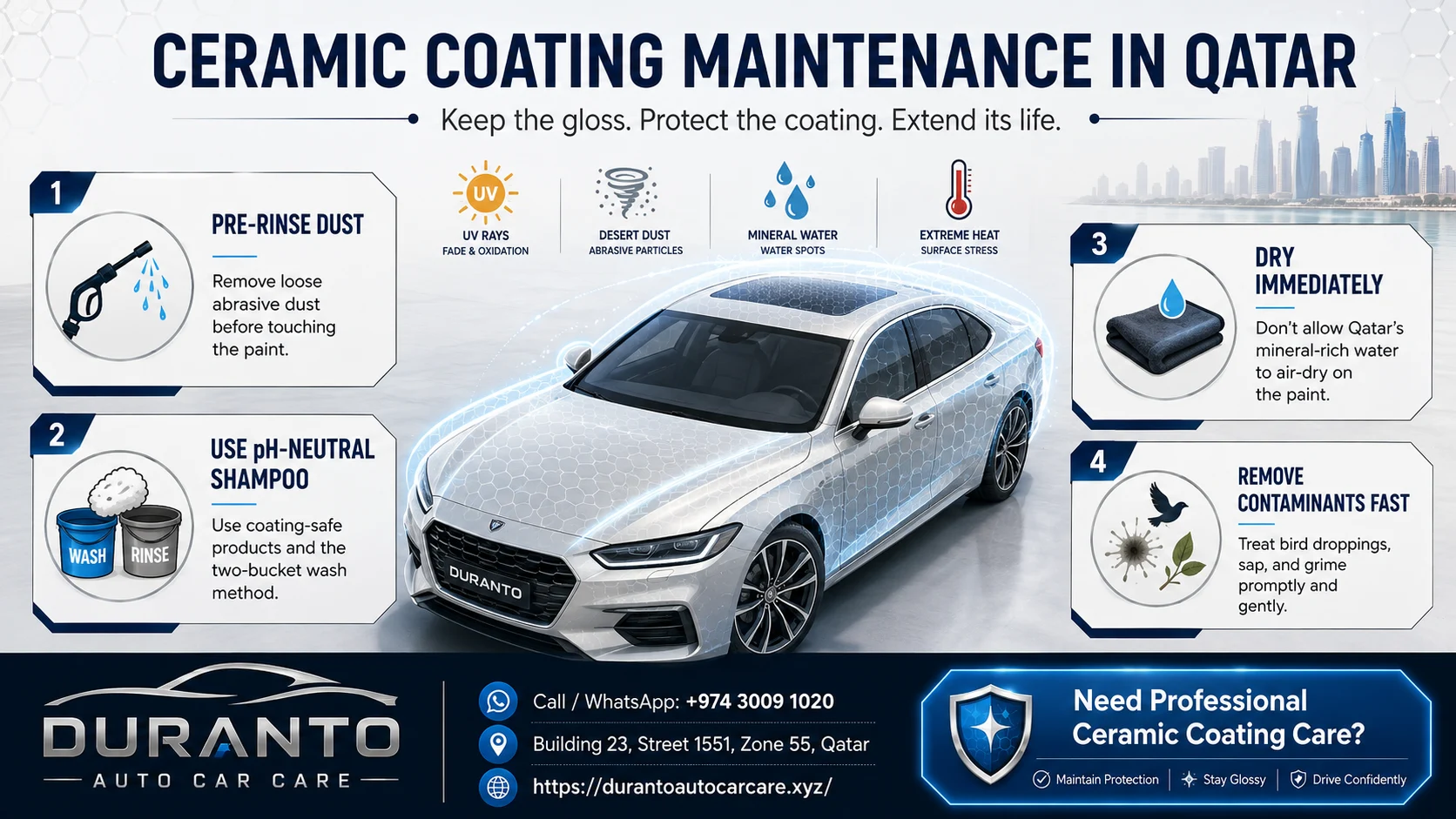
Qatar’s airborne particulate matter is pervasive and highly abrasive. It settles continuously, and the common reflex, dry‑wiping with a cloth, is effectively sanding the surface. Always pre‑rinse with a gentle stream of water to dislodge heavy particles before any physical contact. This non‑negotiable step prevents the fine scratches that dull optical clarity.
2. The Hard‑Water Spot Epidemic
Qatari tap water has a high mineral content (calcium and magnesium). When this water evaporates rapidly under summer sun, it leaves concentrated deposits that can etch into the coating if left unattended. Wash exclusively in the shade or during cooler twilight hours. Utilise a microfiber drying towel immediately after rinsing; do not allow water to evaporate naturally.
3. Thermal Degradation
Prolonged exposure to extreme ambient heat accelerates the breakdown of environmental contaminants and can gradually stress the polymer structure. Vehicles parked outdoors daily see a noticeably shorter effective lifespan for their protective layer compared to garaged counterparts. If your manufacturer recommends a booster spray, consider applying it more liberally during the peak summer months, but never exceed their prescribed frequency.
Step‑by‑Step Maintenance Protocols, Ceramic coating maintenance Qatar
Once the initial curing is fully verified, implement this systematic routine. It forms the core of responsible aftercare.
1. Wash Frequency: Condition over Calendar
There is no universal “every fortnight” rule. Frequency depends on usage, parking environment, and dust exposure. A garaged vehicle driven sparingly may only require a wash every four weeks. A daily driver parked outdoors during sandstorms might need weekly attention. The pragmatic gauge is tactile: when the surface feels gritty or appears dull, wash it.
2. The Two‑Bucket Methodology
This is the professional standard for wash safety.
- Bucket A: pH‑neutral car shampoo diluted with water.
- Bucket B: Plain water for rinsing the wash mitt.
- After each panel, rinse the mitt in Bucket B before recharging with soap.
Using a grit guard in each bucket traps dislodged debris, preventing them from being reintroduced to the paint surface.
3. Product Selection (Real‑World Tested)
Based on direct testing and feedback, we categorically recommend:
- pH‑neutral shampoos specifically labelled for coated vehicles. Avoid dish soap, degreasers, or high‑alkaline detergents; they slowly hydrolyse the hydrophobic top layer.
- Plush microfiber towels (high GSM) for both washing and drying. These are gentle and absorbent.
- Booster sprays only if explicitly prescribed by your coating brand. Do not apply boosters universally; some systems are designed to perform for years without them, and unnecessary application can cause residue buildup. When in doubt, ask your installer.
4. Correct Drying Technique
Never air‑dry a coated car in Qatar. The rapid evaporation leaves mineral deposits. Use a clean, soft drying towel to blot or gently wipe water off in sections. Avoid circular rubbing; use straight lines to minimise visible swirls.
5. Immediate Decontamination
Acidic bird droppings and sugary tree sap are corrosive. In summer heat, they bake into the surface within two hours.
- Action: Remove them immediately using a dedicated insect/tar remover or a diluted isopropyl alcohol solution (10–15% IPA with water—check with your installer first). Gently dab, let it dwell for 30–60 seconds, then blot away. Never scrub aggressively; the goal is to dissolve the contaminant without abrading the coating.
Consolidated Pitfalls: What Experienced Detailers See Most
Rather than repeating scattered advice, we have condensed the most frequent errors into a concise list:
- Ignoring the cure timeline. Washing or getting the car wet before the manufacturer’s drying period expires is the definitive cause of premature failure.
- Using abrasive brushes or automatic car washes. The bristles harbour dirt from previous vehicles and inflict microscopic scratches that compromise surface uniformity.
- Applying harsh chemical cleaners. All‑purpose degreasers and wheel cleaners are not pH‑neutral; they strip the siloxane bonds that create hydrophobicity.
- Skipping pre‑rinse. Wiping a dry, dusty car is the fastest route to dulling the finish.
- Assuming the coating eliminates washing. Regular dirt accumulation still needs removal to prevent etching from long‑term contact.
- Over‑applying products. Wax, polish, or sealants that are not explicitly approved by the coating manufacturer will not bond and may leave a hazy, sticky film; in most cases, they are counterproductive.
How to Choose a Qualified Ceramic Coating Installer in Qatar
When it comes to ceramic coating, the installer matters more than the coating brand. Even the best ceramic coating will fail if it is rushed, applied over contaminated paint, or installed without proper levelling. Here is what to look for—and what to avoid.
What to Look For
- Manufacturer Certifications
Certification is one of the best indicators of a quality installer. Major ceramic coating brands require installers to complete training before they can use and sell their products. These certifications mean the installer has been trained on proper application techniques, has access to professional‑grade products, and is held to quality standards.
A certified coating installer has completed manufacturer‑specific training programs—not weekend crash courses. Real certification means the installer has learned proper surface preparation, application techniques, curing processes, and aftercare protocols directly from the product manufacturer.
How to verify: Ask which brands they are certified with. Then check the manufacturer’s website; most have installer locators where you can confirm certification. A legitimate shop will happily show you its credentials.
- Paint Correction Experience
Any installer offering professional ceramic coatings should have extensive experience with paint correction. Paint correction is not optional; it is the foundation of a successful coating installation. A professional installer evaluates the paint, identifies defects, and determines the appropriate level of correction before applying any coating.
An installer who offers ceramic coating without discussing paint correction is either cutting corners or misunderstanding the process.
- Portfolio and Reviews
Look at actual work they have done, not just marketing photos. What to look for in photos:
- Before and after shots of the same car
- Photos taken in direct sunlight or under inspection lights (not just flattering angles)
- Close‑up shots showing paint correction results
Check Google reviews specifically for coating work, not just general detailing. High‑quality reviews often reference how the paint looked months after installation, how easy the vehicle was to wash, and how the installer explained maintenance requirements.
- Facility Conditions
Ceramic coating needs a clean, controlled environment to cure properly. Dust, humidity, and temperature all affect the outcome. A coating applied in a dusty garage or outdoor driveway can trap debris, cure unevenly, or fail to bond correctly.
Good facilities have:
- Climate control (temperature and humidity)
- Filtered air or dust control
- Good lighting (including inspection lights)
- Clean, organised workspace
Ask if you can see the workspace. A reputable shop will be happy to show you where they work.
Questions to Ask Before Booking
- What specific ceramic product are you applying?
If the shop will not name the product, they are either using a no‑name discount coating or rotating products in a way that prevents you from comparing.
- What paint correction prep do you do before ceramic application?
Quality installs always include, at minimum, a single‑stage polish to clear surface defects before ceramic. Better installs include multi‑stage correction when paint condition warrants it.
- Where is the application happening, shop or mobile?
Multi‑stage paint correction is meaningfully better in shop lighting. If your paint needs serious correction, the shop is the better environment.
- How long does the install take?
Quality ceramic on a medium vehicle is 6‑10 hours of skilled labour (wash + decontamination + correction prep + application). Anyone offering to coat your vehicle in a couple of hours is cutting corners somewhere.
- Is the warranty in writing?
Get specifics. Does it require annual inspections? Specific maintenance products? What exactly is covered—peeling, water spotting, loss of gloss?
- What maintenance is required after ceramic coating?
Ask about proper washing techniques, pH‑neutral shampoos, and coating boosters to extend the lifespan of the coating.
- What is included in the contract? What is excluded? What circumstances could void the warranty?
Warning Signs of Low‑Quality Application
Red flags that should make you walk away:
- Refusal to show certification credentials
- No mention of specific product brands
- Promises of coating application without paint correction
- Pricing that seems too good to be true
- No detailed process explanation
- Missing aftercare instructions
- Rush jobs with same‑day turnaround
- Vague or dismissive answers about prep work
If someone gets defensive or vague about their training, that is your first red flag.
What a Quality Installation Looks Like
After a proper application, your vehicle should have:
- Deep, glass‑like gloss that looks almost wet—uniform from all viewing angles
- Tight water beading—water should form round droplets that roll off easily
- Slick, smooth texture—your hand should glide effortlessly over the surface
- Even coverage across all panels—no missed spots, high spots, or streaks
Our Professional Ceramic Coating Maintenance Checklist
This is the in‑house checklist we provide to clients to streamline their routine:
Daily / Visual
- □ Scan for bird droppings or sap; neutralise instantly using the blotting method.
- □ If dusty, perform a gentle hose‑rinse before using a mitt.
Bi‑Weekly (or as indicated by visual condition)
- □ Hand wash with pH‑neutral shampoo using the two‑bucket method.
- □ Dry completely with a plush microfiber towel; do not air‑dry.
- □ Inspect for water spotting; use a spot‑remover if necessary.
Every 3–6 Months
- □ Assess water beading. If beading is visibly diminishing, apply the manufacturer’s recommended booster (if any).
- □ Check for bonded contaminants (tar, industrial fallout) that might require a clay‑bar or fine‑grade polish (professional).
Annually (or per Warranty Terms)
- □ Schedule a professional inspection and decontamination session.
- □ Have the hydrophobicity and film thickness measured if using premium packages.
The Return on Investment: Is It Worth the Cost?
Assessing value in this context requires considering Qatar’s aggressive automotive environment. A pristine paint finish significantly enhances resale value. Furthermore, the recurring cost of professional polishing and correction (which a coating forestalls) often outweighs the initial outlay.
Pricing in the local market:
- Entry‑level professional coating: ~600 QAR (single layer, 6‑month warranty) – typically suited for newer vehicles.
- Mid‑range multi‑layer: ~1,500 QAR (3 layers, 2‑year warranty) – includes multiple inspection visits.
- Premium extended warranty packages: 5,000–6,000+ QAR (sometimes covering up to 10 years) – involve multiple coats and stringent annual recertification.
If you value your time and care about maintaining that just‑detailed appearance, the investment justifies itself, provided you commit to the care regime. Unprotected paint in Qatar suffers measurable clear‑coat breakdown within two to three years of outdoor exposure.
Frequently Asked Questions About Ceramic Coating Maintenance in Qatar
What is the single most important rule after application?
Adhere strictly to your installer’s specified no‑water curing period. This ranges from 48 hours to a full week depending on the brand. Violating this is the number one cause of reduced durability.
How do I know my protective layer is failing?
The primary indicator is a change in water behaviour. Water should bead tightly and roll off. When it starts sheeting flat or sticking, the hydrophobic properties are depleted. Fading gloss and increased dirt adherence are secondary signs.
Can I use a pressure washer?
Yes, but exercise caution. Maintain a minimum distance of 30–40 cm and avoid using high‑pressure jets on the edges of panels, lights, or emblems. A wide fan pattern is safer than a pinpoint blast.
Is it safe to park under trees to avoid the sun?
No. In Qatar, trees often secrete sap and attract birds. Tree sap and bird droppings are more chemically aggressive than sunlight, causing etching faster than UV alone. Prefer shaded structures (carports) over natural foliage.
Do I need to apply wax?
Generally, no. Most traditional waxes cannot bond to the silica‑based surface and will leave a hazy residue. Some manufacturers produce specialised compatible toppers; only use those explicitly approved for your specific coating.
How often do professionals need to inspect the vehicle?
Typically annually. However, some high‑warranty packages (5–10 years) require inspections every 12 months to maintain coverage. Check your service contract for mandatory appointments.
Does ceramic coating protect against stone chips?
No. It provides very limited resistance to light scratches and swirls but will not prevent rock chips or key scratches. For that level of protection, consider paint protection film (PPF) on high‑impact areas.
What are the signs of a poor ceramic coating installation?
Look for a dull, cloudy, or patchy finish; high spots or streaks visible under direct sunlight; uneven water beading across panels; and a tacky or sticky surface feel.
Conclusion: Sustainability of Your Paint Protection
Owning a vehicle in Qatar is a significant financial commitment. From purchase to registration, fuel, and inevitable toll charges, the expenses accumulate rapidly. Your surface protection is an integral component of that investment portfolio.
Ceramic coating maintenance in Qatar is not merely cosmetic—it is an act of asset preservation. With nine months of extreme UV annually, a neglected coating will degrade, exposing the substrate to oxidation, fading, and etching. Conversely, a carefully maintained film preserves the clear coat, reduces the need for expensive machine polishing, and keeps your car visually competitive in the second‑hand market.
Your structured approach:
- Cure deliberately – follow the explicit timeframes for your product.
- Wash intelligently – using appropriate pH‑balanced soaps, the two‑bucket method, and immediate drying.
- React instantly to corrosive contaminants (droppings, sap, industrial fallout) using blotting—never rubbing.
- Boost judiciously – only using products recommended by your manufacturer.
- Inspect periodically – with professional eyes to catch early signs of contamination or wear.
When that relentless July sun beats down, and your vehicle retains its liquid‑glass shine, while the car beside it appears dull and chalky, you will recognise the value of consistent care. Your coating shields your car; your maintenance shields your coating. It is a partnership that, when honoured, delivers enduring results.
About the author: This guide was compiled by the technical team at White Crown Care Qatar, drawing on over six years of professional detailing, paint correction, and nano‑ceramic application experience across the Doha metropolitan area.