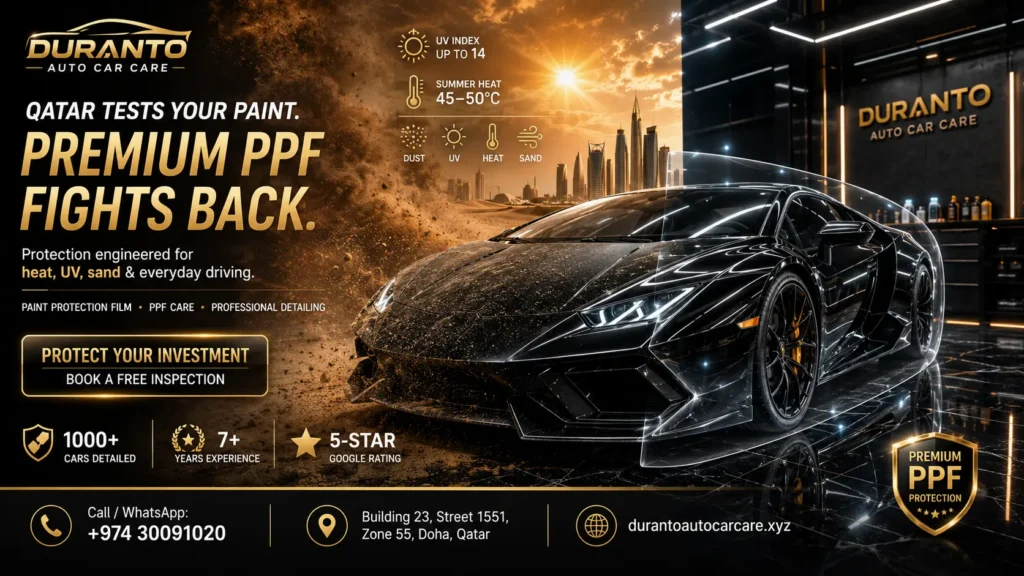
Properly maintaining paint protection film in Qatar is not optional; it is essential for shielding your vehicle from one of the harshest climates on earth. Qatar experiences UV Index values reaching 14 in June, with annual averages of 10.1 to 10.2.
Ambient summer temperatures routinely hit 45–50°C, and parked dashboard surfaces can exceed 90°C. Dust storms affect the country roughly 7.1% of the year, carrying fine silica particles that act as micro‑abrasives.
Budget films, especially those using aromatic TPU rather than aliphatic TPU, can oxidise and yellow visibly within just 1–2 years under this level of UV bombardment. In the wider Gulf region, film exposed to the sun for three to five years commonly begins to bubble, peel, or discolour at the edges.
This is why a dedicated approach to PPF care in Qatar is non‑negotiable. You are not simply cleaning a film; you are preserving sophisticated polymer technology against extreme heat, intense radiation, and frequent sandstorms.
Related Guides (Qatar PPF Topical Cluster)
- How Long Does PPF Last in Qatar? – Lifespan expectations, warranty coverage, and when to replace your film.
- Best PPF for Qatar Heat: TPU vs TPH vs PVC – Which material survives 50°C summers and which fails.
- PPF vs Ceramic Coating in Qatar – Physical protection vs chemical enhancement—what your car actually needs.
- How Much Does PPF Cost in Qatar? – Full‑body vs front‑end pricing, what affects cost, and where to find value.
- Full‑Body vs Front‑End PPF in Qatar – Coverage options compared for local driving conditions.
- Can PPF Withstand Qatar Sandstorms? – How the film performs during sandstorm season and what to expect.
- PPF Warranty Guide for Qatar – What warranties cover, what they exclude, and how to keep yours valid.
- How to Wash a PPF Car in Qatar – The two‑bucket method, pressure washer rules, and sandstorm cleaning protocol.
- PPF Yellowing: Causes and Prevention – Why films turn yellow in the Gulf sun and how to prevent it.
Why This Climate Demands Special Attention
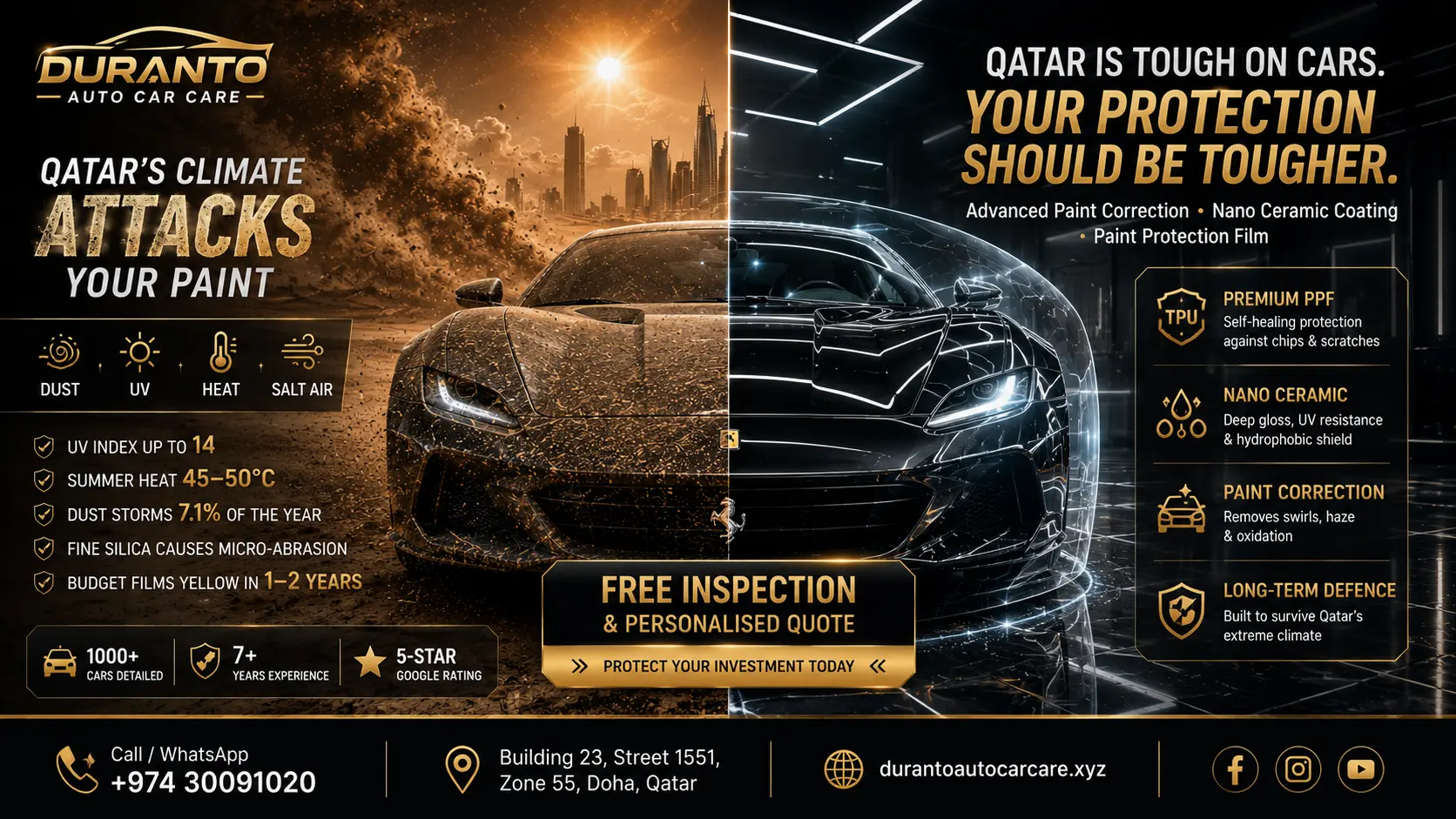
Qatar presents a triple threat to automotive paint: extreme heat, relentless UV, and abrasive sand.
Heat – Road surfaces run 6–10°C hotter than ambient air. On a dark‑coloured bonnet parked in direct sun, panel temperatures frequently exceed 80°C. Standard pressure‑sensitive adhesives begin to soften at 85–90°C, which can cause visible adhesive ooze at seam lines and eventual bond failure if the film is not formulated for these conditions.
UV Radiation – The Middle East receives roughly double the annual UV dose of Northern European markets. Without sufficient UV inhibitors and stabilisers, clear coats oxidise rapidly—especially on horizontal panels like the roof and bonnet.
Sand and Dust – Wind‑borne particles, ranging from 63 to 250 microns, travel at speeds of 93–109 km/h during storms. This material settles as a layer of sharp, microscopic grit. Dry‑wiping that dust into your film is equivalent to rubbing fine sandpaper across the surface.
The First Seven Days: A Critical Window
Paint protection film uses a water‑based adhesive that takes time to achieve full bond strength. During the initial curing period, any moisture, pressure, or friction can compromise that bond.
Professional installers consistently report that the most common early failures occur when owners wash their cars within the first week, particularly with high‑pressure automatic washes.
The jet force, aimed at panel gaps, can pierce the adhesive before it has cured, leading to lifted edges and trapped contamination that is often irreversible without a partial re‑wrap.
Essential rules for days 1–7:
- Do not wash – no hand wash, no pressure wash, no touchless wash.
- Avoid heavy rain – water can intrude at edges.
- Keep the car dry – no sprinklers, no enthusiastic hosing.
- Do not pick at edges or bubbles – minor bubbles or haze are normal moisture venting; poking creates permanent damage.
If dust accumulates: In Qatar, dust does not pause for a week. A light rinse with water only no soap, no wiping is acceptable. Pat dry gently with a clean microfiber. No rubbing or pressing.
How to Wash a PPF‑Equipped Car
Frequency – Wash every 1–2 weeks, and more often during sandstorm season. The longer abrasive dust sits on the film, the more it works into the topcoat.
The Two‑Bucket Method:
- Bucket 1: pH‑neutral car shampoo and water.
- Bucket 2: plain water for rinsing your wash mitt.
After washing each panel, rinse the mitt in Bucket 2 before re‑dipping into Bucket 1. This prevents dirt and grit from being rubbed back onto the surface.
What to Use:
- DO: pH‑neutral shampoos (pH ~7.0), soft microfiber wash mitts, clean microfiber drying towels, PPF‑safe spray detailers.
- DO NOT: harsh chemicals, degreasers, bug removers (unless PPF‑safe), traditional waxes, ceramic coatings not designed for PPF, rough sponges, brushes, or automatic brush washes.
Step‑by‑step process:
- Pre‑rinse – remove loose dust before touching.
- Snow foam (optional) – apply pH‑neutral foam, let it sit for a few minutes; do not let it dry.
- Hand wash – top to bottom, two‑bucket method.
- Rinse – remove all soap residue.
- Dry – pat dry with clean microfiber towels. Qatar’s hard water leaves mineral spots, so drying is essential.
Pressure washer precautions:
- Keep the nozzle at least 12–18 inches from the surface.
- Never spray directly at film edges at a 90‑degree angle.
- Avoid high pressure on edges, seams, and corners.
Sandstorm Cleaning Protocol
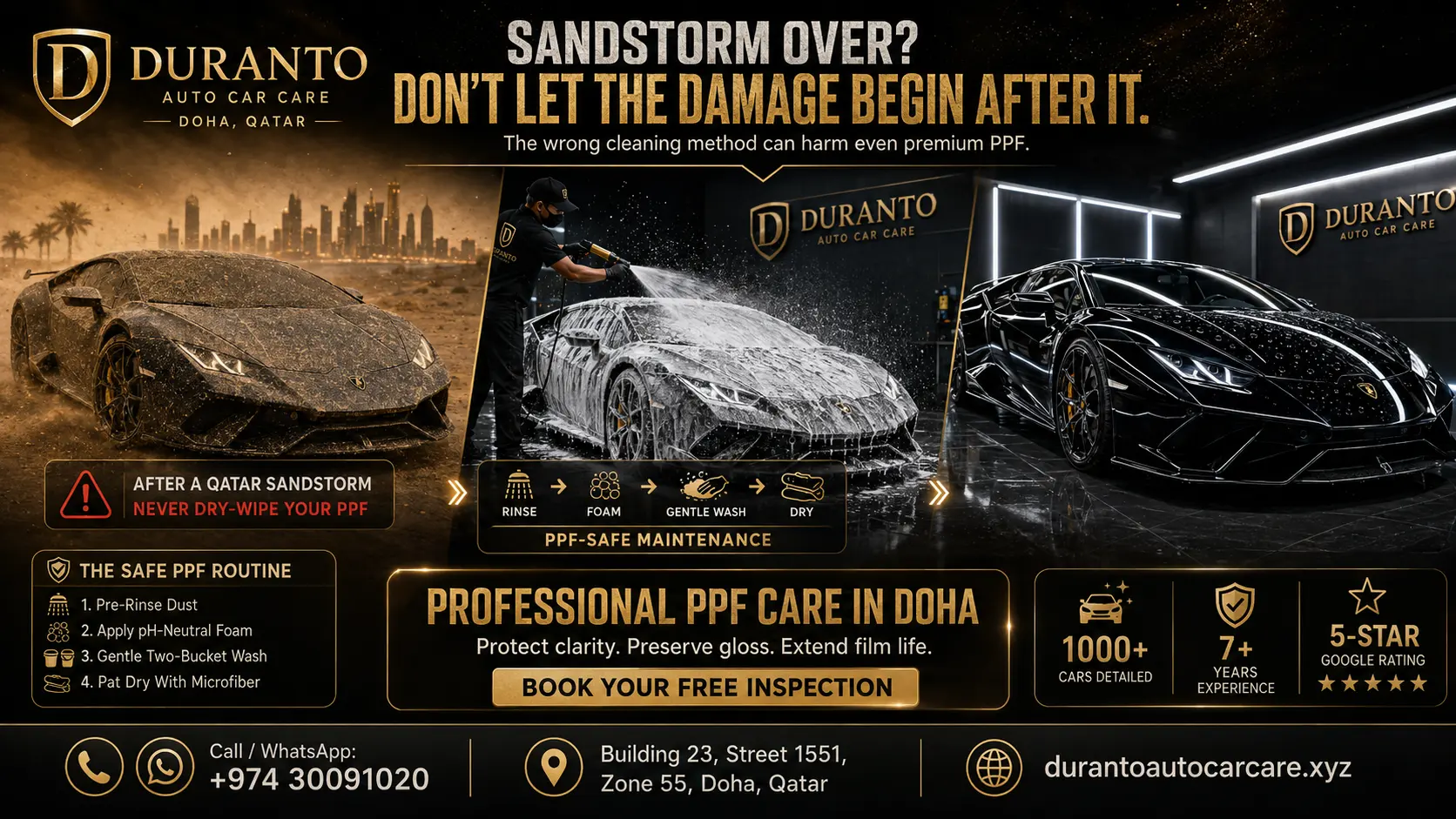
After a sandstorm, never wipe a dry PPF surface. Rinse loose sand off before touching the film.
Procedure:
- Touchless pre‑rinse – start from the roof down. Use a pressure washer (12–18 inches away) or a hose with a solid jet. Water should carry away 80–90% of the grit without any physical contact.
- Snow foam soak – apply generous pH‑neutral foam and let it dwell for 5–7 minutes. The foam encapsulates remaining particles and provides lubrication.
- Gentle hand wash – only after rinsing off most grit. Use the two‑bucket method with pH‑neutral shampoo.
- Final rinse and dry – thoroughly rinse and pat dry.
Self‑healing limits: Premium films self‑heal minor swirl marks with heat (e.g., SunTek Ultra activates above 120°F / ~49°C). However, self‑healing is not designed for deep gouges or the aggressive abrasion caused by dry‑wiping sand. Proper PPF washing and aftercare preserves this feature; abuse will overwhelm it.
Common PPF Maintenance Mistakes in Qatar
- Choosing an installer purely on price
A full wrap on a luxury SUV costs 10,000–25,000 QAR. Lower prices often mean rushed prep, uncalibrated blades, or unskilled labour—resulting in lifted edges, trapped dust, alignment gaps, or even cut clear coat. Choose certified technicians with climate‑controlled bays and computer‑cut (DAP/plotter) templates. 3M Certified Installers, for example, use thousands of computer‑designed patterns for a precise fit. - Using incorrect products
Harsh chemicals degrade topcoats; non‑PPF waxes or coatings can cause discolouration or interfere with self‑healing. Stick to pH‑neutral, PPF‑safe products only. - Washing in direct sunlight
Qatar’s sun makes soap and water dry instantly, leaving residues and spots. Wash in the shade or during cooler hours. - Skipping regular inspections
Edges lift, contaminants trap, and stains develop over time. A weekly visual check looking for lifted edges, trapped debris, or staining near seams catches small issues before they become expensive repairs. - Ignoring organic contaminants
Bird droppings, tree sap, and bug splatter are acidic and can etch PPF. Remove them immediately: rinse to soften, then gently wipe with a microfiber. Never scrub dry.
Quality PPF: What to Look For in Qatar
When selecting a film for this climate, demand these specifications:
- 100% aliphatic TPU – Resists yellowing. Aromatic TPU or PVC yellows within 1–2 years.
- Hard top coat – Middle East‑spec films often use a pencil hardness of 4H (ASTM D3363), compared to standard 3H, for better scratch resistance.
- High UV protection – Look for 99% UV rejection with elevated HALS (Hindered Amine Light Stabilizers) loading—typically 30–40% higher than standard European specifications.
- Self‑healing activation – Should activate at accessible temperatures (above 120°F / ~49°C).
- Heat‑stable adhesive – KSB’s Middle East specification, for example, uses PSA formulated with a Tg above 95°C, keeping it in the elastic (non‑flowing) regime at standard Qatari temperatures.
Manufacturer Specifications
3M™ Scotchgard™ Pro Series
- 0.203 mm (203μm) ultra‑transparent, self‑healing polyurethane.
- Self‑healing formula that enables minor scratches to disappear.
- Proprietary clearcoat for additional UV protection.
- Withstands high heat, UV exposure, and salt spray.
- 10‑year warranty against yellowing, bubbling, and cracking (Certified Installer required).
XPEL ULTIMATE PLUS
- 8 mil (~203 microns) thickness.
- Self‑healing top coat.
- UV protection prevents paint fading.
- Stain‑resistant, hydrophobic surface.
- Up to 10‑year warranty.
SunTek Ultra
- 8 mil total thickness, 99% UV rejection.
- Self‑healing activates above 120°F (~49°C).
- 99.5% optical clarity.
- 5 to 12‑year lifespan depending on product.
PPF Warranty in Qatar
Premium brands back their products with substantial warranties:
- 3M Pro Series: 10‑year warranty against yellowing, bubbling, and cracking.
- XPEL: Lifetime warranty available in Qatar.
- LLumar Platinum Extra: 10‑year limited warranty.
- SunTek: Manufacturer’s limited warranty (professional installation required).
Warranties typically exclude damage from improper maintenance, watermarks, and physical impact. This is another reason why protecting PPF from Qatar heat and following correct care procedures is essential not only for appearance but also to keep your warranty valid.
Frequently Asked Questions
How long does PPF last in Qatar’s climate?
With proper care, premium PPF lasts 5–12 years. 3M Pro Series and LLumar offer 10‑year warranties against defects. Inferior films (aromatic TPU or PVC) may yellow or fail within 1–2 years. Choose aliphatic TPU with UV stabilisers.
Can I take my car through an automatic car wash?
Avoid brush automatics; brushes scratch the film, and high pressure can lift edges. Touchless is slightly better, but hand washing remains the safest option.
When can I first wash the car after installation?
3–7 days. Some Qatari installers recommend a full 7 days due to the heat. Always follow your installer’s specific guidance.
Will Qatar’s sun damage my PPF?
That depends entirely on quality. Premium films use aliphatic TPU with UV inhibitors. 3M Pro Series has a proprietary clearcoat for UV defence and a 10‑year no‑yellowing guarantee. SunTek Ultra offers 99% UV rejection. Inferior aromatic TPU yellows within 1–2 years.
Can self‑healing technology fix deep scratches?
No. It is designed for fine scratches and swirl marks. Deep gouges require panel replacement.
Should I wax my PPF?
Traditional wax: no. PPF‑specific sealants or ceramic coatings, yes, but only those explicitly labelled as PPF‑safe.
How do I remove bird droppings?
Immediately. Rinse to soften, then gently wipe with a microfiber. If stubborn, use a PPF‑safe cleaner or consult your installer.
Is PPF really worth it in Qatar?
Absolutely. With a UV Index 14 in summer and sandstorms affecting the country 7.1% of the year, PPF protects your paint, preserves resale value, and keeps your car looking new, backed by up to lifetime warranties from leading brands.
What is the typical maintenance cost?
DIY supplies: ~100–200 QAR per month. Professional detailing: 300–800 QAR per session. Compared to a 10,000–25,000 QAR installation, this is a small price for long‑term protection.
Conclusion
You invested in paint protection film to guard against rock chips, scratches, UV degradation, and the daily wear of Qatari roads. Maintaining PPF in Qatar is a commitment that preserves both your car’s appearance and its resale value.
Key takeaways:
- Respect the cure time – the first 7 days are critical.
- Wash regularly (every 1–2 weeks) with correct, pH‑neutral products and techniques.
- After a sandstorm, never dry‑wipe – rinse, foam, then gently wash.
- Use only PPF‑safe shampoos, sealants, and towels.
- Inspect weekly for edge lifts, stains, or trapped contaminants.
- Choose quality – both in film (aliphatic TPU with UV inhibitors) and installer (certified professionals).
Premium films 3M Pro Series (10‑year warranty), XPEL (lifetime in Qatar), SunTek Ultra (99% UV rejection), are engineered for extreme environments. But even the best technology requires ongoing care. Treat your film correctly, and it will reward you with years of clarity, gloss, and protection.
When you have any doubts about PPF maintenance in Doha or elsewhere in the country, consult your installer. They know your specific film, your vehicle, and the unique challenges of the local climate. Park in the shade whenever possible, and enjoy the drive.