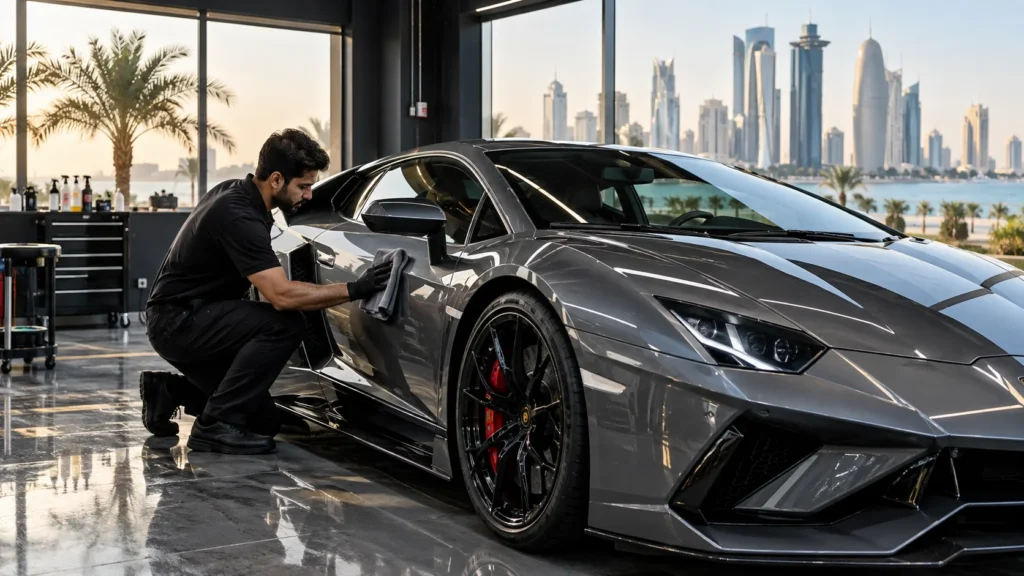
Duranto Auto Car Care | Doha, Qatar
Supercar detailing Qatar is a different job from supercar detailing anywhere else. Not because the process changes, but because the environment attacks paint from four directions at once: sun, sand, salt, and water, and each damages the clear coat differently.
We’ve been correcting paint and installing protection on supercars in Doha for years. The cars arriving at our facility every week tell a consistent story: dark-coloured cars dulling within a year, water spots from garden-hose rinses that have already etched into the clear coat, and swirl marks from dry wipes that cost more to remove than the original coating would have cost to install.
This guide covers what a professional detail actually involves, how the protection products compare, what each service costs, and how to judge whether a detailer is qualified to work on a car worth more than most people’s homes.
At Duranto Auto Car Care, we handle ceramic coating, paint protection film, and multi-stage paint correction for Ferrari and Lamborghini vehicles, along with Porsche, McLaren, and Aston Martin models, across Doha, Lusail, The Pearl, West Bay, and Al Wakrah.
What Arrives at Our Facility Every Week
Before getting into products and pricing, it is worth describing what actually shows up on our bay. These are patterns from our own work, not general claims.
Dry-wipe swirl marks. The most common issue by a wide margin. When dust sits on paint and gets wiped off with a dry cloth, the silica in that dust drags across the clear coat like fine sandpaper.
We see this on cars that are otherwise well looked after — the owner wipes the car down after every drive, thinking they are doing the right thing. A single dry wipe on a dusty black Ferrari hood can introduce a dozen swirl marks that take machine polishing to remove.
Water spot etching. Usually from garden-hose rinses. Doha’s tap water carries dissolved minerals. When it dries on paint, the minerals stay behind and, over time, etch into the clear coat. We have corrected cars where the water spots had been sitting for six months and required two-stage polishing to remove. On cars where they had been sitting for a year or more, some marks were permanent.
Oxidation on the horizontal panels. Hood, roof, and rear deck fade first because they face the sun directly.
A car parked outdoors daily will show measurable gloss loss on those panels within twelve to eighteen months. Dark colours are worse; white and silver hide it longer but suffer the same underlying UV damage.
Interior heat damage. Leather that has dried, cracked, or stained. Alcantara on steering wheels that has matted down from hand contact, sweat, and heat. Carbon fibre trim with clear coat that has yellowed.
These are not rare cases. They are the standard condition of supercars in Qatar that have not had a proper care schedule.
If you want to see real examples of each, our gallery has before-and-after photos from our own work.
Why the Qatar Climate Is Hard on Paint
Qatar’s environmental threat to cars comes from four sources.
Sun Exposure
Qatar receives some of the highest solar radiation levels in the world. The Doha summer is brutal: months of direct sun with very little cloud cover. UV radiation breaks the molecular bonds in clear coat through photo-oxidation, which is why the horizontal surfaces of your car always age first.
Heat also accelerates everything else. A car parked in direct sun for eight hours a day is chemically more active than one parked in shade. Contaminants bond faster, water evaporates faster, leaving minerals behind, and the paint itself expands and contracts more.
We see this in our own intake records. Cars parked outdoors consistently arrive in worse condition than cars parked in covered parking, even when both are washed on the same schedule.
Airborne Sand and Silica
Qatar’s air carries fine dust most days of the year, and construction sites across the country add silica particles to the mix. Silica is harder than automotive clear coat. When dust sits on your paint, it is slowly abrading the surface every time you touch it or the wind moves it across the car.
Salt Air
If you live or park near the coast The Pearl, Lusail Marina, West Bay your car is exposed to salt-laden air daily. Salt accelerates corrosion on exposed metal and etches into clear coat where it settles and stays wet. We see this most in brake calipers, suspension hardware, and exposed under-car components.
Water Quality
Qatar’s tap water is desalinated. It is safe to drink, but it carries dissolved minerals that leave deposits when it dries. Those minerals etch into the clear coat if left on the paint. This is why we use filtered, deionised water in every wash, and why we never let a car air-dry.
How Threat Levels Vary Across Qatar
| Area | Primary Threat | Secondary Threat | Risk Level |
| The Pearl | Salt air + humidity | Waterfront sun exposure | High |
| Lusail | Construction dust | UV + heat | High |
| West Bay | Interior damage from sun | Salt air | Moderate |
| Central Doha | Traffic film + general dust | UV | Moderate |
| Al Wakrah | Airborne sand | UV, less salt | Moderate |
| Msheireb | Construction dust | Urban fallout | Moderate–High |
If you park outdoors, add one service tier to whatever you would otherwise choose. If you park in a climate-controlled garage, you can maintain protection on a slightly longer cycle.
What Happens During a Professional Detail
Many businesses in Qatar advertise “detailing” when what they offer is a hand wash with an interior wipe-down. Here is what a genuine professional detail involves, in order, and why each step matters.
Step 1 — Assessment
Before anything touches the paint, we take electronic paint depth readings across every panel. This tells us how much clear coat remains, and therefore how aggressively we can polish without risking a burn-through.
Ferrari clear coat is thinner than most owners assume. McLaren’s is on the thin side too. Porsche tends to be harder.
We also document existing damage photographically so there is a clear record of the car’s condition before any work starts.
Skipping this step is how detailers destroy paint. It is also why a detailer who does not own a paint depth gauge should not be working on your car.
Step 2 — Decontamination
Two chemical stages followed by one mechanical stage.
Iron remover dissolves embedded ferrous particles brake dust, rail dust, industrial fallout. It turns purple as it reacts.
Tar and sap solvent breaks down organic deposits that iron remover does not touch.
Clay bar treatment pulls the remaining bonded contamination off physically. When done correctly, the paint should feel glass-smooth afterwards. If it feels rough, the decontamination is not finished.
Step 3 — Paint Correction
This is the step that separates a real detail from a wash. Machine polishing removes swirl marks, scratches, and oxidation by levelling the clear coat. It is also the step amateurs most often ruin.
Correction happens in stages:
- Heavy cut — removes deeper defects. Used sparingly.
- Medium polish — removes moderate swirl marks and refines the surface.
- Finishing polish — brings out maximum gloss and removes any marring introduced by earlier stages.
Ferrari paint responds differently to polishing than McLaren or Porsche. Ferrari clear coat is generally softer and requires less aggressive compounds. Porsche clear coat is harder and tolerates more aggressive cutting but needs more refinement afterwards. We adjust per panel based on depth readings and how the paint responds to a test section.
A full correction on a supercar typically takes 20 to 40 hours depending on paint condition and vehicle size.
Step 4 — Protection
Once the paint is corrected, it needs protection. There are three main options, and they are not interchangeable.
Comparing Your Protection Options
| Factor | Ceramic Coating | Paint Protection Film | Wax / Sealant |
| Primary function | Chemical + UV protection | Physical impact protection | Temporary gloss + light protection |
| Stops stone chips | No | Yes | No |
| Blocks UV | Yes | Yes | Partially, short-lived |
| Repels water | Excellent | Good | Moderate |
| Typical lifespan in Qatar | 2–5 years | 5–10 years | 4–8 weeks |
| Heat resistance | Excellent | Excellent | Poor (degrades fast in summer) |
| Self-healing | No | Yes (heat-activated) | No |
| Wash difficulty | Very easy | Easy | Moderate |
| Best for | Overall protection, easy maintenance | High-impact zones or full-body | Short-term or low-use vehicles |
| Relative cost in Qatar | Moderate | Higher | Low |
Ceramic coating and PPF solve different problems. Coating protects against chemicals and sunlight. Film protects against physical impact. Most of our supercar clients choose both, film underneath for impact, coating on top for easier washing and additional UV resistance.
A car with only wax in Qatar is effectively unprotected by the end of the first summer.
PPF Coverage Options
| Coverage | Panels Protected | Best For | Relative Cost |
| Partial front | Bumper, partial hood, mirrors | Budget-conscious, highway use | Lowest |
| Full front | Bumper, full hood, fenders, mirrors, headlights | Regular driving, track days | Moderate |
| Track package | Full front + rockers + rear quarters | Enthusiast use | Moderate–High |
| Full body | Every painted panel | Supercars, long-term ownership, maximum protection | Highest |
Full-body film is the standard recommendation if you plan to keep the car long-term or resell within the GCC market. Partial front is a reasonable compromise for a leased vehicle or one that lives mostly in a garage.
Ceramic Coating Qatar: An Honest Breakdown
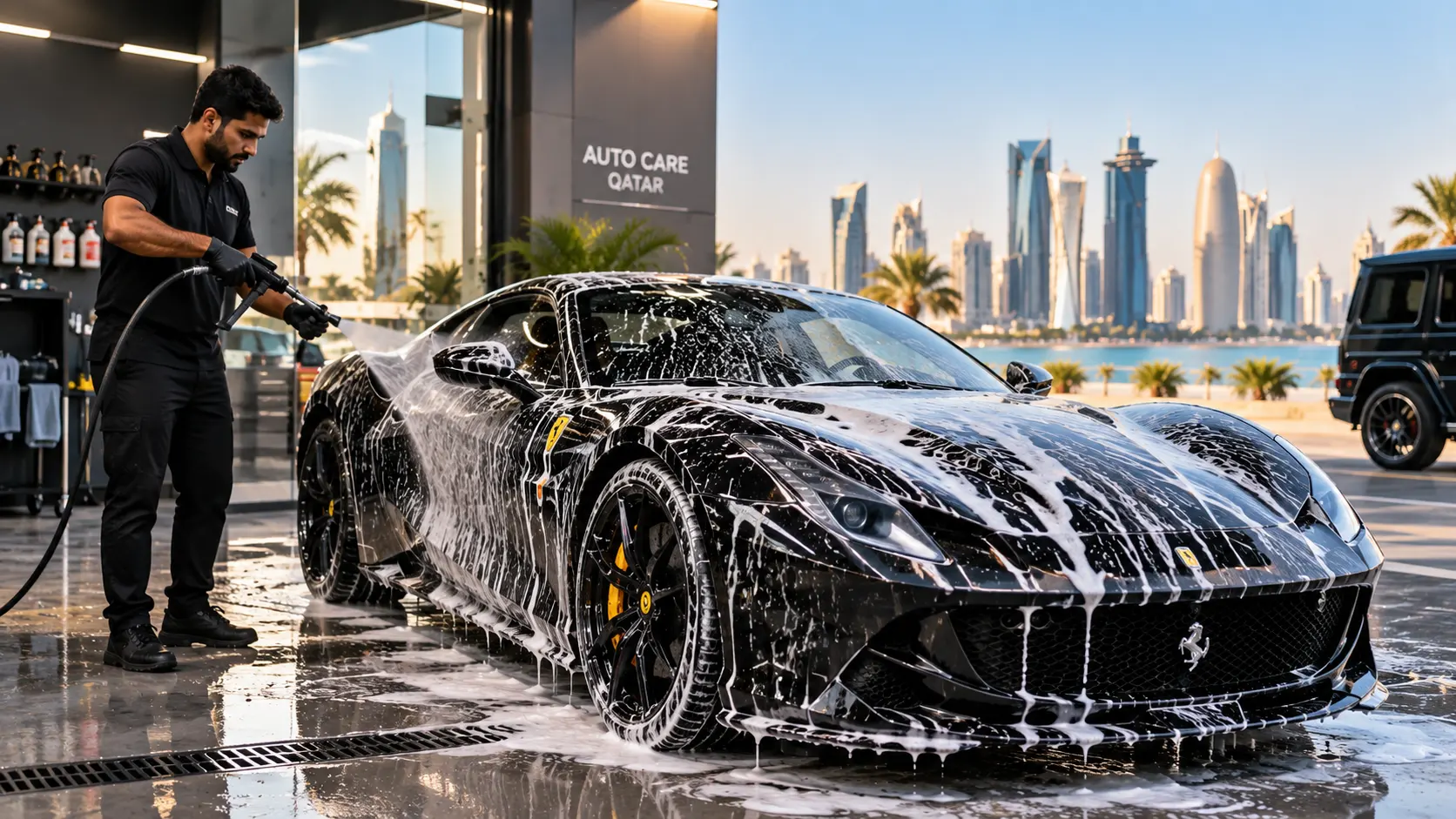
Ceramic coating Qatar owners ask about is often oversold. Let’s be accurate about what it does.
What It Actually Does
Ceramic coating is a liquid polymer, usually silicon dioxide (SiO₂), that bonds to your clear coat at a molecular level. Once cured, it forms a semi-permanent layer chemically bonded to the paint, not sitting on top like wax.
What it delivers:
- UV blocking — the primary cause of oxidation and fading in Doha
- Hydrophobic behaviour — water beads and rolls off, reducing water spot formation
- Chemical resistance — bird droppings, tree sap, industrial fallout
- Added gloss — fills microscopic surface imperfections
- Easier cleaning — contaminants struggle to bond to a coated surface
What it does not do:
- Stop stone chips
- Absorb physical impact
- Eliminate the need for washing
- Make your car scratch-proof
Anyone telling you a coating makes your car scratch-proof is selling you something.
Coating Tiers
| Tier | Typical Lifespan | Maintenance Required | Best Suited To |
| Entry-level coating | 1–2 years | Regular washing, annual top-up | Lease vehicles, short ownership |
| Mid-tier coating | 3–4 years | Scheduled maintenance washes | Most supercar owners |
| Premium coating | 5+ years | Strict maintenance schedule | Long-term ownership |
| Multi-layer systems | 5–8 years with top-ups | Professional maintenance only | Investment-grade vehicles |
The lifespan figures assume a proper maintenance wash schedule. A coating on a car washed at a petrol station with harsh detergent will fail early regardless of what you paid.
We offer maintenance plans for coated vehicles that include scheduled washes, annual inspections, and coating booster applications.
Paint Protection Film Qatar: Physical Defence
Paint protection film Qatar installs solve the problem coating cannot. Film absorbs physical impact. Stone chips from the highway, light scratches from car parks, and abrasion from blowing sand hit the film instead of the paint.
How Self-Healing Film Works
Modern film uses elastomeric polymers that reflow when heated. Minor scratches the kind you get from fingernails or light brushing disappear on their own once the film reaches a certain temperature. In Qatar, surface temperatures climb high enough in direct sunlight that self-healing happens naturally.
Installation Quality Matters More Than the Product
The best film in the world is useless if it is installed badly. Common installation failures we see on cars that come to us after a bad experience elsewhere:
- Lifting edges — from improper surface preparation or inadequate stretching
- Dirt under the film — from installing in a dusty environment
- Visible seams — from poor panel wrapping technique
- Bubbles — from moisture trapped during installation
- Blade marks — from trimming film on the car rather than before installation
A proper installation requires a dust-controlled bay, a trained installer, and time. A full-body film install on a supercar takes two to three days. If someone promises to do it in one day, walk away.
Radical Autoworks covers additional mistakes to avoid. The most common one remains assuming a single product is enough protection.
Ferrari Detailing Doha and Lamborghini Detailing Qatar
Ferrari and Lamborghini paint behave differently enough that they deserve their own section.
Ferrari Detailing in Doha
Ferrari clear coat is generally on the softer side compared to German manufacturers. That means it polishes easily — and scratches easily too. A Ferrari that gets wiped down dry will show swirl marks faster than almost any other supercar.
The Rosso Corsa family of colours is the most requested, and also the most revealing. Red pigment amplifies both gloss and defects. Under direct sunlight, swirl marks on a red Ferrari are impossible to hide. This is why we check every Ferrari under multiple light sources before, during, and after correction.
Full correction on a Ferrari typically runs longer than on a harder-paint car because we cannot be aggressive. We cut less per pass and accept more passes to get the same result. It is slower, but it preserves clear coat thickness, which matters enormously on a car that may be polished again in five years.
Lamborghini Detailing in Qatar
Lamborghini paint systems vary significantly by model and by the finish ordered. Standard gloss paints behave differently from matte and satin finishes, and both require different products and techniques.
Matte finishes are the biggest trap for owners. They cannot be polished in the traditional sense, cannot be waxed, and most consumer car care products will leave streaks or shine patches that permanently ruin the finish.
A matte Lamborghini washed at a general car wash is a matte Lamborghini that will need a respray within a year or two.
We handle matte and satin finishes with dedicated products designed for those surfaces.
What We Do Differently on These Marques
- Lower machine speed and lighter pads on soft Italian clear coat — reduces heat, reduces the risk of marring
- More passes at lower aggression — preserves clear coat thickness
- Matte-specific cleaning and protection products — never standard wax or gloss coating
- Test sections on every panel — we do not assume uniformity across a car
- Depth gauge readings before and after — recorded, not estimated
Interior Detailing in Qatar: The Overlooked Half
Most owners focus on paint. But the interior is where the sun does its most expensive damage.
Leather in a supercar is not the same as leather in a family SUV. Ferrari uses full-grain and semi-aniline hides with minimal protective coating to preserve the natural feel. That minimal coating makes them more vulnerable to UV drying, cracking, and staining.
Alcantara used on steering wheels, seat centres, and headliners in most modern supercars is essentially a high-tech suede. Water-based cleaners damage it. The wrong product mats the fibres permanently. UV exposure breaks it down faster than almost any other interior material.
What Professional Interior Work Involves
- Leather cleaning with pH-balanced products formulated for automotive leather
- Leather conditioning to restore oils lost to heat and UV
- UV protection applied to all leather and plastic surfaces
- Alcantara treatment using dry-cleaning methods that do not wet the fibres
- Carbon fibre care gentle cleaning that preserves the weave without damaging the clear coat over it
- Electronic surface care: screens, touch panels, and switchgear cleaned with appropriate methods
- Odour elimination via ozone treatment or enzymatic cleaners that neutralise odours rather than masking them
A properly maintained supercar interior looks and smells new after five years. A neglected one shows every kilometre.
DIY vs Professional: The Real Numbers
The economics of DIY detailing look good on paper. In practice, in this climate, they usually are not.
Three-Year Cost Comparison (Typical Supercar Owner in Qatar)
| Item | DIY Approach | Professional Approach |
| Supplies (shampoo, towels, wax, tools) | QR 1,500 over 3 years | Included in service |
| Your time | 100+ hours/year | Zero |
| Risk of swirl marks / damage | High | Minimal |
| Paint correction needed | Every 2–3 years: QR 3,000–8,000 | Rarely, if maintenance followed |
| Ceramic coating | Not feasible DIY | QR 6,000–12,000 amortised over 3–5 years |
| PPF | Not feasible DIY | QR 8,000–25,000 depending on coverage |
| Resale value impact | −10 to −15% | Premium maintained |
| Net position after 3 years | Higher cost, worse condition | Higher upfront, better resale |
The maths only favours DIY if nothing goes wrong. In Qatar, something almost always does.
APC Detail makes a similar point about preserving value. The economics hold in Qatar with larger stakes.
Exotic Car Detailing Qatar: The Resale Value Case
Two identical 2021 Porsche 911 Turbos. Same mileage, same spec, both for sale in Doha.
Car A: Detailing maintained on schedule. Coating intact. Paint free of swirl marks. Interior clean.
Car B: Washed occasionally at a petrol station. No protection. Visible swirl marks in direct sunlight. Leather showing wear on the driver’s bolster.
Car A sells faster and for more. On a QR 1.5M vehicle, the paint and interior condition gap commonly accounts for 10 to 20% of the sale price — between QR 150,000 and QR 300,000.
Exotic car detailing Qatar: owners schedule properly know it is not a cosmetic expense. It is a maintenance line item that protects resale value, exactly like servicing the engine or replacing tyres.
JBR Capital’s supercar care guide makes the same point for the UK market. The logic holds here with larger stakes, because the Qatar market is smaller and buyers are more selective.
Maintenance Schedule for Qatar
| Frequency | Service | Purpose |
| Weekly | Hand wash with filtered water, pH-neutral shampoo | Remove dust before it bonds |
| Monthly | Maintenance detail — wash, coating booster, interior wipe, glass, wheels | Keep coating performing |
| Quarterly | Decontamination wash, leather conditioning, engine bay | Remove bonded contamination, preserve interior |
| Annually | Full decontamination, paint inspection, coating top-up, interior deep clean | Correct minor issues before they compound |
| Every 2–3 years | Paint correction if required, coating renewal | Restore gloss, refresh protection |
Adjust upward if you park outdoors, drive daily, or store near active construction. Adjust downward only if the car is garaged, coated, and driven rarely.
Seasonal Adjustments
Summer: Peak UV. Interior protection is critical. Wash frequency should increase.
Winter: More comfortable for outdoor work. Occasional rain means water spot risk from rain-borne dust. Salt exposure along the coast remains constant.
Transitional periods: Sandstorm season. Consider additional protection on exposed surfaces and keep windows up when parked outdoors.
We offer maintenance plans built around your actual usage rather than a fixed template.
How to Judge a Detailer Before You Hand Over the Keys
Qatar’s detailing market has grown fast. Not every business advertising “professional detailing” is equipped to work on a supercar.
Questions Worth Asking
- How many supercars have you personally detailed?
- Do you use a paint depth gauge before polishing?
- Which coating and film brands do you install, and why?
- Can you show me before-and-after photos of similar vehicles?
- Are you insured?
- What is your warranty on coating and film?
- What is your process if something goes wrong?
- How long does a full correction take?
A genuine professional will answer all of these without hesitation. Someone who cannot answer the paint depth question is not qualified to polish your car.
Red Flags
- Quotes given without inspecting the car
- No paint depth gauge on site
- Promises to “remove all scratches” without explaining that some defects are too deep to remove safely
- Prices significantly below the market
- No fixed facility; mobile-only services for correction and coating work
- Pressure to decide on the spot
Flatirons Detailing Co. has written on mastering supercar detailing. The approach meticulous, informed, patient is the standard to hold any detailer to.
MID-ARTICLE CTA #3
Have questions about your specific car?
Send us the model and a few photos on WhatsApp. We will reply with an honest assessment and a quote.
Areas We Serve Across Qatar
Duranto Auto Car Care is based in Doha and works with supercar owners across the country. Qatar is small enough that distance is rarely a barrier, but the environmental challenges genuinely differ by district and so does the care your car needs.
If you are not sure whether we cover your area, or whether collection and delivery are available where you live, send us a message, and we will confirm.
Supercar Detailing Doha
Doha is our home base and where most of our work happens. We regularly handle vehicles from West Bay, Al Dafna, Al Sadd, Msheireb, Katara, and the diplomatic quarter. Central Doha presents a mixed threat profile traffic film and general urban dust combined with strong UV exposure for cars parked outdoors.
If you are based in central Doha and your car lives in a covered garage, you are in the easiest category to maintain. If it is parked outdoors during the workday, you are in one of the harder ones.
Luxury Car Detailing Lusail
Lusail is one of the highest-risk areas we serve. The ongoing development across Lusail City means airborne construction dust is a constant and that dust contains silica, which is harder than your clear coat. Cars in Lusail that are not protected will accumulate swirl marks faster than cars in almost any other district.
We handle a significant share of our ceramic coating and PPF work for Lusail-based owners. If you park anywhere near an active construction zone, full-body PPF plus ceramic coating is the standard recommendation.
Exotic Car Protection The Pearl
The Pearl sits directly on the water, which means salt-laden air is a daily reality. Salt is a different threat from dust it does not scratch, but it etches into clear coat wherever it settles and stays wet, and it accelerates corrosion on exposed metal components.
For The Pearl, we recommend coating with strong chemical resistance and, where possible, film on high-exposure panels. Interior protection also matters more here because humidity accelerates leather degradation.
Ceramic Coating West Bay
West Bay presents a different mix. The towers provide covered parking for many residents, which reduces direct UV exposure on the car’s surface during the day. But the interior still heats up significantly when the car is driven and parked, and salt air from the bay adds a secondary threat.
Cars in West Bay are typically the best-cared-for in our client base, simply because garaging slows damage. Coating maintenance is usually a lighter schedule here than in Lusail or Al Wakrah.
Ferrari Detailing Al Wakrah
Al Wakrah sits further south and away from the heaviest coastal humidity, but airborne sand from the surrounding desert is a more consistent issue than it is in central Doha. Sand is abrasive, and it finds its way into every panel gap, window seal, and air intake.
We handle some Ferrari and Lamborghini owners in Al Wakrah and the surrounding southern areas. For this location, film on the front end and rockers is close to essential if the car is driven regularly.
Other Areas We Cover
Beyond the five main districts above, we regularly work with owners in:
- Al Rayyan — mixed urban and residential. Similar profile to central Doha.
- Umm Salal — closer to desert, higher airborne sand exposure.
- Al Khor — northern coast, salt air exposure comparable to The Pearl.
- Dukhan — western industrial area, higher industrial fallout levels.
- Msheireb — dense urban construction, elevated silica dust exposure.
Location Summary
| District | Best-Suited Service | Why |
| Doha (central) | Maintenance detailing + coating | Moderate UV and dust, mostly covered parking |
| Lusail | Full-body PPF + ceramic coating | Heavy construction dust |
| The Pearl | Ceramic coating + interior protection | Salt air and humidity |
| West Bay | Ceramic coating + maintenance plan | Covered parking, moderate salt exposure |
| Al Wakrah | PPF (front + rockers) + coating | Airborne sand |
| Al Khor | Coating with high chemical resistance | Coastal salt exposure |
| Msheireb | Coating + regular decontamination | Construction dust |
Frequently Asked Questions
How often should a supercar be detailed in Qatar?
Monthly maintenance with a full annual detail, assuming the car is coated and garaged. Increase frequency if parked outdoors or driven daily. Coastal areas like The Pearl and Lusail Marina warrant closer attention because of salt exposure.
Is ceramic coating in Qatar worth it?
Yes, more so here than in temperate markets because UV and heat exposure are higher year-round. A quality coating lasts two to five years with proper maintenance and makes routine washing significantly easier.
What is the difference between ceramic coating and paint protection film?
Ceramic coating provides chemical and UV protection at a molecular level. Paint protection film provides physical impact protection as a film layer. They solve different problems. Combined, film underneath, coating on top, you get both.
Can I wash my supercar myself?
You can maintain a coated car with careful hand washing using filtered water and pH-neutral shampoo. What you cannot safely do yourself is paint correction, coating application, or PPF installation. Those require training, equipment, and a controlled environment.
How much does supercar detailing in Qatar cost?
Maintenance details typically start around QR 500–1,000. Full paint correction with ceramic coating generally falls between QR 5,000 and QR 15,000 depending on vehicle size, paint condition, and product selected. Contact us for an itemised quote.
Do you offer mobile detailing?
Maintenance detailing can be done on-site across Doha, Lusail, The Pearl, West Bay, and Al Wakrah. Correction and coating work is done at our facility.
Do you work on Ferraris and Lamborghinis specifically?
Yes. Ferrari detailing Doha and Lamborghini detailing Qatar are two of our most common jobs. Paint systems differ significantly between manufacturers, and we adjust compound, pad, and technique accordingly.
How long does a full detail take?
A maintenance detail takes three to six hours. A full correction with coating can take 20 to 40 hours or more. A full-body PPF install takes two to three days.
Will detailing void my manufacturer’s warranty?
Professional detailing performed by qualified specialists using appropriate products will not void your warranty. Amateur detailing that causes damage could affect warranty coverage for those specific issues.
Do you serve clients outside Doha?
Yes, Lusail, The Pearl, West Bay, Al Wakrah, Al Rayyan, Umm Salal, Al Khor, and surrounding areas.
Conclusion
Supercar detailing in Qatar is not optional maintenance. It is the difference between a vehicle that appreciates in condition and one that quietly loses value in a car park.
Whether you search for luxury car detailing in Doha or exotic car detailing in Qatar, the standard you should hold any provider to is the same: paint depth readings, staged correction, appropriate products for your paint system, and honest advice about what your car does and does not need.
Ceramic coating Qatar and paint protection film Qatar are the two protection decisions that matter most in this climate. Ferrari detailing Doha and Lamborghini detailing Qatar require specialist knowledge that general detailers do not have.
And where you drive matters. A car in Lusail faces different threats than one in The Pearl or Al Wakrah. The right service depends on which one you are.
The information in this guide applies to every supercar in Qatar regardless of who does the work. The difference is in the execution.