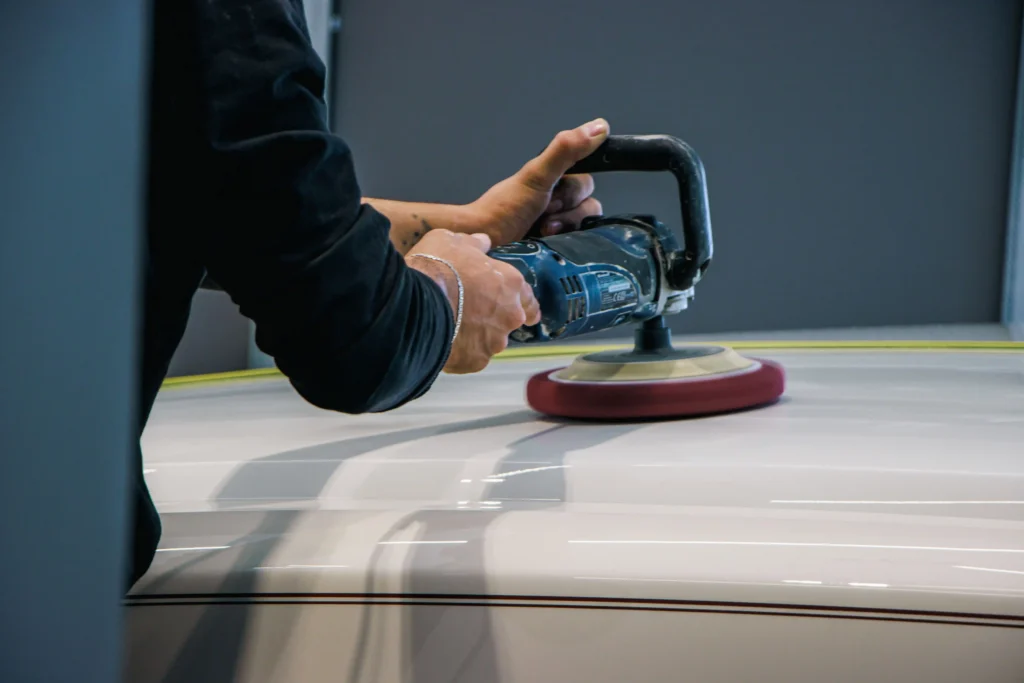
Paint correction permanently removes swirl marks, light scratches, oxidation, water spots, and holograms by precisely leveling your car’s clear coat. Unlike waxes or glazes that temporarily fill and hide imperfections, paint correction actually eliminates them by abrading away the damaged layer of clear coat. The result is optically clear paint that reflects light evenly, restoring that deep, liquid-glass showroom shine you see on new cars and exotics.
What Does Paint Correction Do?
When you ask what paint correction to do, the answer is both simple and sophisticated. At a mechanical level, it removes a microscopic layer of your car’s clear coat—typically 1 to 5 microns—to eliminate the scratches and imperfections embedded in it. At a visual level, it restores the paint’s ability to reflect light with specular clarity, giving you that deep, wet, mirror-like finish.
Here is the breakdown of what paint correction does in practical terms:
| Aspect | What Paint Correction Does |
| To Clear Coat | Levels the surface by removing 1–5 microns of damaged clear coat |
| To Defects | Permanently eliminates swirl marks, light scratches, and oxidation |
| To Gloss | Restores specular reflection, creating deep, liquid-glass shine |
| To Longevity | Prepares paint for protection; extends the life of the finish |
| To Resale Value | Can increase vehicle value by 10–20% when properly maintained |
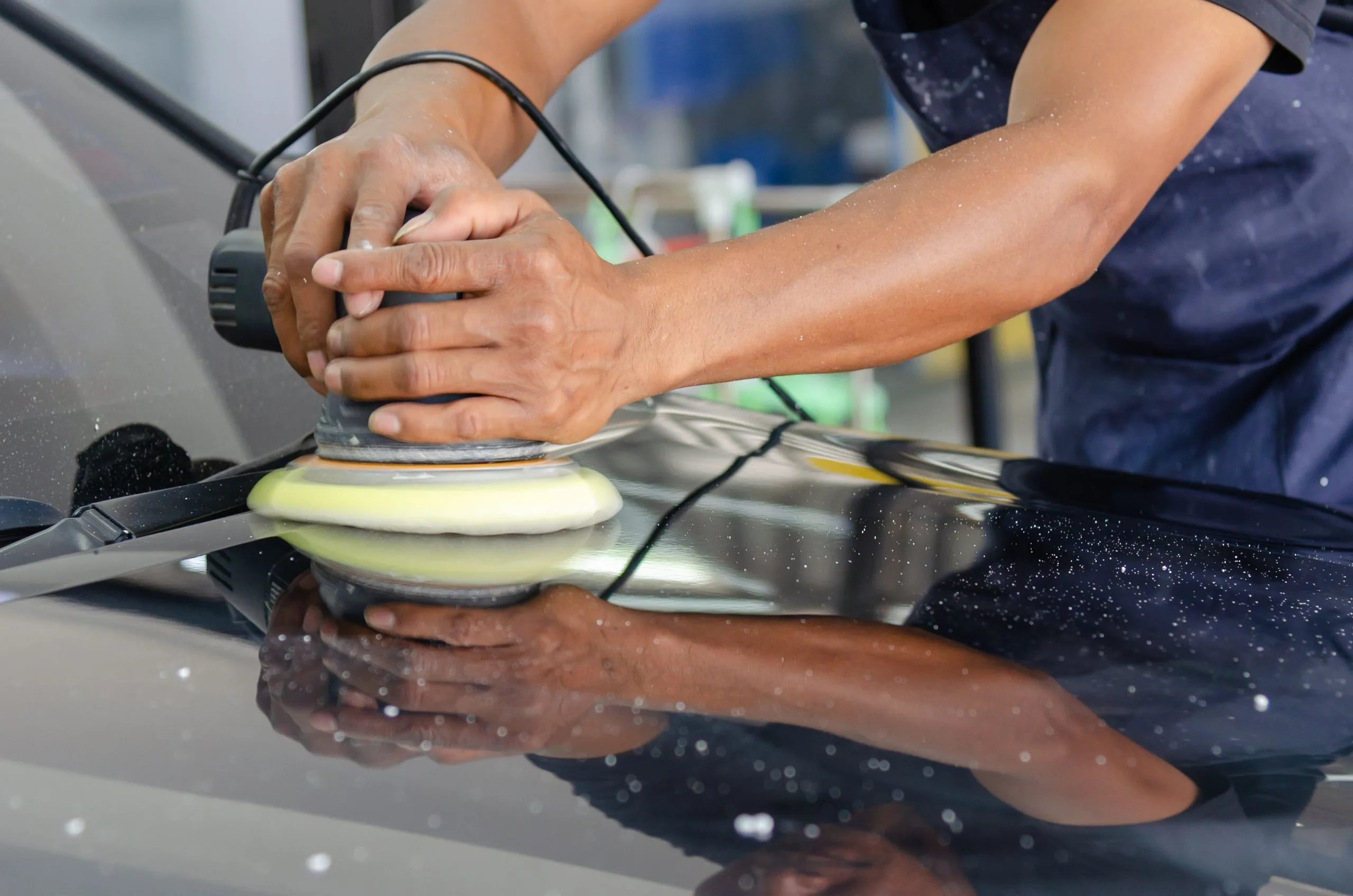
The process is performed using a machine polisher (typically a dual-action polisher for safety), abrasive compounds, and specialized foam or microfiber pads. A professional detailer works section by section, carefully monitoring paint thickness with a digital gauge to ensure they remove only what is necessary.
According to Mike Phillips, a renowned detailing expert, “Compounding removes paint. Polishing removes a little paint.” The key is removing just enough to eliminate defects while preserving the clear coat’s protective integrity. This is why what paint correction does depends so heavily on the skill of the person performing it.
What Defects Does Paint Correction Remove?
Paint correction is designed to address a specific range of surface-level imperfections. Here is what it can eliminate:
| Defect | What It Looks Like | Cause |
| Swirl Marks | Spider-web patterns visible in direct sunlight | Improper washing/drying with dirty mitts or towels |
| Light Surface Scratches | Fine linear marks (fingernail does not catch) | Brushing against bushes, dirty wash mitts, dust wiping |
| Oxidation | Faded, chalky, or dull appearance | UV exposure breaking down clear coat over time |
| Water Spots (Mineral Etching) | Circular rings or spots that remain after washing | Hard water drying on paint, acid rain |
| Holograms / Buffer Trails | Curved, rainbow-like marks visible in sunlight | Improper use of rotary polishers without finishing step |
| Haze / Dullness | General lack of luster and clarity | Accumulation of micro-scratches over years of wear |
These are the defects that professionals refer to when answering what does paint correction do. Each of these imperfections scatters light rather than reflecting it, which is why your car looks dull and lifeless even after a thorough wash.
What Paint Correction CANNOT Fix
As impressive as paint correction is, it has limits. Here is what it cannot fix:
| Defect | Why It Can’t Be Corrected | Alternative Solution |
| Deep Scratches (Fingernail Catches) | Scratch has penetrated through clear coat into base coat | Touch-up paint, wet sanding, or panel repaint |
| Rock Chips | Missing paint where clear coat and base coat are gone | Touch-up paint or professional chip repair |
| Deep Key Scratches | Often goes down to primer or bare metal | Panel repaint required |
| Rust Spots | Metal corrosion beneath the paint | Rust treatment and repaint |
| Clear Coat Failure | Clear coat has completely worn away or delaminated | Full panel repaint |
| Orange Peel (Heavy) | Factory texture in the clear coat | Wet sanding (aggressive; separate service) |
The fingernail test is the easiest way to determine if a scratch can be corrected: run your fingernail gently across the scratch. If it does NOT catch, what does paint correction do for that scratch? It removes it. If it catches, the scratch is too deep—paint correction will only reduce its appearance, not eliminate it.
<a id=”paint-correction-vs-polishing-vs-waxing”></a>
Paint Correction vs. Polishing vs. Waxing
Understanding the difference between these three services is critical to making an informed decision. Here is a direct comparison:
| Factor | Paint Correction | Polishing | Waxing / Sealing |
| What It Does | Permanently removes defects by leveling clear coat | Removes light oxidation; adds gloss | Fills imperfections temporarily; adds a protective layer |
| Defect Removal | 50–98% (permanent) | 10–30% (surface-level only) | 0% (masks defects with oils and fillers) |
| Duration of Results | Permanent (defects are gone) | 2–4 months | 1–6 months |
| Clear Coat Removed | 1–5 microns | Less than 0.5 microns | None |
| Time Required | 4–25+ hours | 1–3 hours | 1–2 hours |
| Cost | $300–$2,500+ | $150–$400 | $50–$200 |
| Best For | Restoring neglected or swirled paint | Maintaining good paint | Regular protection and shine enhancement |
Here is the simple breakdown of what paint correction does versus the alternatives:
- Waxing is like putting concealer on a pimple—it hides the problem temporarily. The fillers wash away after a few weeks.
- Polishing is like using a facial scrub—it cleans the surface and adds some glow but doesn’t remove deeper imperfections.
- Paint Correction is like microdermabrasion—it actually removes the damaged layer, revealing fresh, flawless skin underneath.
If a shop offers “paint correction” for $200 and promises to finish in two hours, they are polishing—not correcting. True correction is slow, skilled, and expensive. There are no shortcuts.
Stage 1 vs. Stage 2 vs. Stage 3 Correction
Paint correction is graded in stages based on the severity of defects and the level of perfection desired. Here is how they compare:
| Stage | Defect Removal | Best For | Time | Price Range |
| Stage 1: Enhancement Polish | ~50–70% | New cars, light swirls, daily drivers | 4–6 hours | $300–$600 |
| Stage 2: Two-Stage Correction | ~80–95% | Moderate swirls, water spots, 3–5 years old | 8–12 hours | $600–$1,200 |
| Stage 3: Multi-Stage / Show Car | ~90–98% | Exotics, concours, heavy neglect, premium coatings | 15–25+ hours | $1,200–$2,500+ |
Stage 1: Enhancement Polish (50–70% Removal)
A single-step process using a medium-cut compound and a polishing pad. According to Gilroy Blackout, this is “best for daily drivers with light swirls and water spots.” It removes about half the defects and adds a noticeable gloss boost.
When to choose Stage 1: Your paint is in decent shape but looks a bit tired. You want a refresh without spending a fortune.
Stage 2: Two-Stage Correction (80–95% Removal)
The most common choice for American car owners. A cutting step removes defects, and a polishing step refines the finish. Appearance Solutions notes that Level 2 achieves approximately 70–80% defect removal, while other sources report 80–95% for two-stage corrections.
When to choose Stage 2: Your car has visible swirl marks and scratches in direct sunlight. You want a dramatic improvement and are planning to keep the car for several years.
Stage 3: Multi-Stage Correction (90–98% Removal)
Three or more steps, starting with heavy cutting and moving to fine polishing. May include wet sanding for severe defects. Appearance Solutions indicates that Level 3 achieves approximately 90% or greater defect removal.
When to choose Stage 3: Your paint is heavily neglected, you own an exotic or show car, or you are applying a premium ceramic coating and want perfection.
Clear Coat Consideration: According to Gilroy Blackout, 45–50 microns of clear coat can tolerate 2–3 full corrections, 55–70 microns can handle 3–4 corrections, and 80+ microns can manage 4–5 corrections. This is why professionals measure paint thickness before correction—”it determines how aggressive they can safely be.”
How Long Does Paint Correction Take?
Time is a critical factor in understanding what does paint correction do and why it costs what it costs. Here is a realistic breakdown:
| Service | Time Required | Why It Takes This Long |
| Stage 1 (Enhancement) | 4–6 hours | Single polishing step; minimal defect removal |
| Stage 2 (Two-Stage) | 8–12 hours | Cutting + polishing; section-by-section work |
| Stage 3 (Multi-Stage) | 15–25+ hours | Multiple cutting steps; wet sanding; show car finish |
| Ceramic Coating (Added) | +2–4 hours | Prep, application, and curing time |
What affects the time?
- Vehicle Size: A compact sedan takes less time than a crew-cab truck or a large SUV.
- Paint Condition: Heavily swirled paint requires more correction time.
- Paint Hardness: Hard German clear coats take longer to correct than soft Japanese paints.
- Desired Results: Show car perfection takes significantly longer than a daily driver refresh.
Expect Auto detailing, the detailer to keep your car for a full day (Stage 1) to several days (Stage 3). Rushed correction is a recipe for holograms, burn-through, and poor results. When asking what does paint correction does to your schedule, plan accordingly.
How Much Does Paint Correction Cost? (2025 USA)
Paint correction costs vary by vehicle size, paint condition, and location. Here is a realistic pricing breakdown:
| Service | Sedan / Coupe | SUV / Truck | What’s Included |
| Stage 1 (Enhancement) | $300–$600 | $400–$800 | Single polish, 50–70% defect removal |
| Stage 2 (Two-Stage) | $600–$1,200 | $800–$1,600 | Cut + polish, 80–95% defect removal |
| Stage 3 (Multi-Stage) | $1,200–$2,500+ | $1,600–$3,500+ | Multi-step, 90–98% removal, show car finish |
| Ceramic Coating (Add-On) | +$1,000–$2,000+ | +$1,200–$2,500+ | Protection layer for 3–9 years |
Wash Doc Auto Detailing provides more granular pricing: $500 for cars (coupes and sedans) and small trucks, $600 for mid-size 2-row SUVs and crew-cab trucks, and $700 for extended 3-row SUVs, large or lifted trucks, vans, and large classic vehicles.
Ceramic Coating Costs (Standalone): According to Ceramic Coating.com, coupe/sedan ceramic coating ranges from $950–$1,600, while SUV/truck ranges from $1,200–$1,900. Premium multi-year coatings can exceed $2,600 for larger vehicles.
Hidden Costs to Watch For:
- Decontamination Fees: Some shops charge extra for heavy iron removal or clay barring.
- Paint Thickness Issues: If your clear coat is too thin, the detailer may limit correction, but you will still pay for their time.
- Wet Sanding: Severe orange peel or deep scratches may require wet sanding, which adds $200–$500 per panel.
Is Paint Correction Worth It?
Let us be honest: paint correction is not cheap. But is it worth the investment? Here is a direct decision framework to help you decide:
You SHOULD Get Paint Correction If:
| Scenario | Why It’s Worth It |
| Swirl marks in direct sunlight bother you | Every drive becomes enjoyable; you take pride in your car |
| You are selling your car in the next 6–12 months | Paint correction can increase resale value by 10–20% |
| You are applying a ceramic coating | A flawless surface ensures the coating bonds perfectly and looks stunning |
| You own a dark-colored car | Dark colors show every defect; correction has a dramatic visual impact |
| You plan to keep the car for 3+ years | You will enjoy the results for years; the cost per year is minimal |
You Should SKIP Paint Correction If:
| Scenario | Why It’s Not Worth It |
| You view your car primarily as transportation | If you do not notice or care about paint defects, save your money |
| You are returning a leased vehicle | The ROI typically is not there for a car you are giving back |
| You are not willing to invest in protection | Without a ceramic coating, PPF, or sealant, the correction will degrade quickly |
| Your car has deep scratches, rock chips, or rust | Correction cannot fix these; you would be paying for incomplete results |
| Your clear coat is too thin | Correction may not be safe; some detailers will recommend against it |
Real-World ROI: A $600 Stage 2 correction on a $12,000 used car can easily translate into a $1,500–$2,000 higher sale price. According to iSeeCars.com, cars with poor paint conditions can lose up to 30% of their value. When you ask what does paint correction does for your wallet, the answer is often: it pays for itself.
Do You Need Paint Correction Before Ceramic Coating?
Short answer: Highly recommended, but not strictly required.
Here is the reality of what paint correction does in the context of ceramic coatings: A ceramic coating is a semi-permanent, glass-like layer that bonds to your clear coat. It adds hydrophobic properties and UV resistance, but it has a critical flaw—it locks in everything beneath it.
If you apply a ceramic coating over a car covered in swirl marks and scratches, you are basically putting a very expensive, very permanent clear plastic wrap over a scratched-up surface. The coating will not “fill” the scratches. It will amplify them by creating a high-gloss layer over the defects, making them even more visible in sunlight.
| Scenario | Result | Recommendation |
| Ceramic Coating over swirled paint | Defects are sealed in permanently; coating reflects and magnifies scratches | Not Recommended |
| Paint correction + Ceramic Coating | Flawless surface is locked in; coating maximizes gloss and depth | Best Practice |
| Ceramic Coating over new, perfect paint | Acceptable if paint is truly flawless (rare) | Optional |
| Paint correction + PPF (Paint Protection Film) | Ultimate protection; PPF can also hide some defects | Premium Option |
According to Appearance Solutions, “After paint correction, paint protection film and/or ceramic coating are highly recommended to protect and encapsulate the newly corrected finish.”
If you are paying $1,000+ for a ceramic coating, skimping on the $600 correction prep is like buying a 4K TV and watching standard-definition channels. You are not getting the full value of your investment.
FAQs About Paint Correction
Q: What does paint correction do that wax cannot?
A: Paint correction removes defects permanently by leveling the clear coat. Wax fills them temporarily—the effect washes away within weeks. When you ask what does paint correction do, the key answer is permanence.
Q: How long does paint correction take?
A: Stage 1: 4–6 hours. Stage 2: 8–12 hours. Stage 3: 15–25+ hours. Expect the detailer to keep the car for a full day or even overnight.
Q: Does paint correction damage my paint?
A: When done correctly by a professional using a paint thickness gauge, no. When done incorrectly by an amateur, absolutely yes. According to Appearance Solutions, “Done professionally, the removal of these imperfections is perfectly safe and will not cause damage to a vehicle’s finish.”
Q: Can I do paint correction myself?
A: Technically yes. Realistically? Probably not. The risks—burning through clear coat, leaving holograms, or uneven results—are significant. If you are determined to try, start with the least aggressive method possible, work in small sections, and invest in a dual-action polisher (not a rotary).
Q: How long do paint correction results last?
A: The correction itself is permanent—those defects are gone. However, new defects will appear over time from washing, driving, and environmental exposure. According to Springs Detailing, “Any marring or scratches removed will be permanent, so long as the vehicle is properly maintained and new imperfections are not introduced onto the surface.”
Q: Does paint correction increase resale value?
A: Yes. According to industry sources, paint correction can increase resale value by 10–20% when properly maintained. iSeeCars.com notes that cars with poor paint conditions can lose up to 30% of their value.
Q: How often should I get paint correction?
A: Most cars only need a full paint correction every 2–5 years, or even less frequently for well-maintained vehicles. Heavy correction should be rare—the clear coat can only endure 3–5 corrections over its lifetime.
Q: What does paint correction do to stone chips?
A: Nothing. Rock chips have penetrated through the clear coat into the base coat or primer. Paint correction cannot fix them—you need touch-up paint or professional chip repair.
Q: Does paint correction remove orange peel?
A: To a small degree, yes. However, factory orange peel is often severe. To truly remove it, you need wet sanding, which is a separate, aggressive process beyond standard paint correction.
Q: What is the difference between rotary and dual-action polishers for correction?
A: Dual-action (DA) polishers are safer and less likely to create holograms. Rotary polishers remove defects faster but require significant skill and an extra finishing step. Most professionals recommend DA polishers for paint correction unless they have extensive rotary experience.
Conclusion
When you ask what paint correction does, the answer is straightforward: it permanently eliminates swirl marks, scratches, oxidation, and haze by leveling your car’s clear coat. It restores that deep, liquid-glass shine that you see on showroom floors and exotics. It prepares your paint for ceramic coatings, PPF, or sealants, ensuring that protection locks in perfection rather than imperfections.
But let us be clear about what paint correction do and what it does not. It does not fix rock chips, deep scratches, rust, or clear coat failure. It does not make your paint bulletproof. It does not eliminate the need for proper washing techniques. And it certainly does not happen quickly or cheaply.
Paint correction is a serious investment of time, money, and clear coat. Industry data shows that factory clearcoat on modern cars is approximately 2 mils (about 50 microns) thin—thinner than a Post-it Note—with only 45–80+ microns of total clear coat to work with, depending on the vehicle. Each correction removes 1–5 microns per stage, meaning you only have a limited number of corrections available over your vehicle’s lifetime.
It requires a skilled professional who uses a paint thickness gauge, performs test spots, works under proper lighting, and gives you honest expectations. It requires protection afterward—ceramic coating, PPF, or, at a minimum, a high-quality sealant, to ensure that investment lasts.
If you are the type of person who parks at the far end of the lot to avoid door dings, who cringes at the thought of an automatic car wash, and who genuinely enjoys seeing your car look its best, paint correction is absolutely worth it.
If you are not? Save your money. There is no shame in that either.
But if you do decide to take the plunge, do it right. Use the checklist. Ask the questions. Find a detailer who will measure your paint, show you test spots, and give you realistic expectations before they touch your car. Your paint—and your wallet—will thank you.