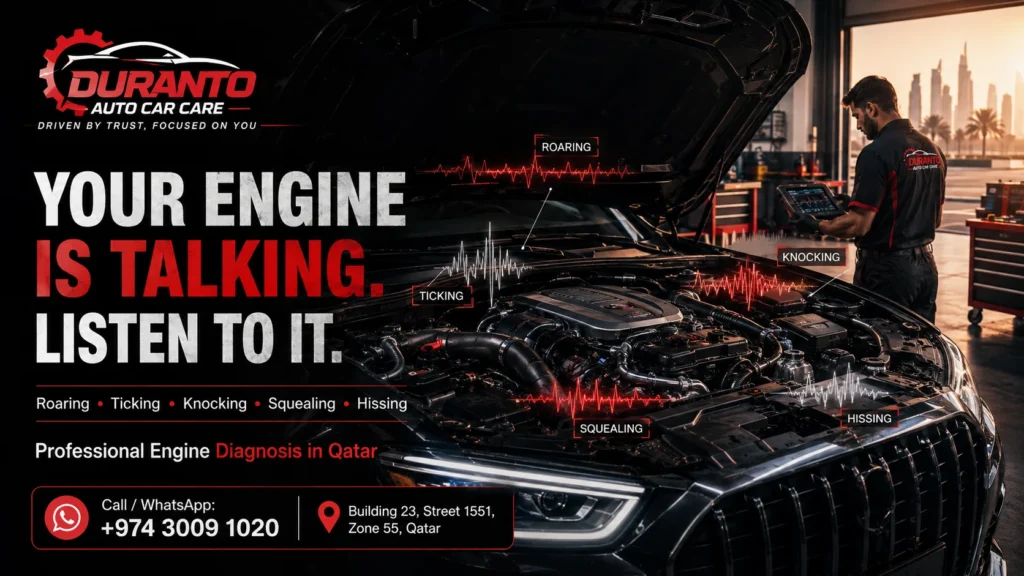
Why Is My Engine So Loud? A Doha Mechanic’s Straight-Talk Guide
Last Updated: July 2026
Reviewed by: Senior Diagnostic Team, Duranto Auto Care
Reading Time: 12 minutes
Let me paint you a picture. You’re cruising down the Corniche, maybe heading toward Lusail, windows up because it’s 45°C outside and your AC is fighting for its life. Suddenly—BAM—your car starts growling like a grumpy camel that missed breakfast. Your heart sinks, right? Because in Qatar, a weird engine noise usually means one thing: a fat repair bill eating into your weekend plans.
I’ve been turning wrenches in Doha for over 15 years, and my team at Duranto Auto Care sees this exact panic every single day. A driver pulls up, face pale, saying, “Habibi, my car sounds terrible. What is it? Is it going to cost me my salary?”
Here’s the truth: engines make noise. That’s normal. But when your car suddenly sounds like a monster truck auditioning for a Hollywood movie, something has changed. And nine times out of ten, it’s fixable. The trick is catching it before that “fixable” turns into “we need to replace the whole thing.”
So grab a drink, take a breath, and let’s walk through exactly what that loud engine noise means. I’ll tell you what to check, what to ignore, and when to call a tow truck—because trust me, breaking down on the Dukhan Highway in August is not a fun story to tell.
Who’s Talking? (Author Bio & Expert Credentials)
Author Bio: My name is Ahmed Al-Mannai, and I’m the Lead Diagnostic Technician at Duranto Auto Care in Doha. I’ve been fixing cars in Qatar for over 15 years, starting as an apprentice in a small garage in the Industrial Area, and working my way up through the ranks.
I’ve seen every make and model you can imagine: from dusty Nissan Patrols that have conquered the dunes to luxury German sedans that spend most of their time crawling through West Bay traffic.
Credentials:
- ASE Certified Master Technician (Automotive Service Excellence)
- Licensed Qatari Mechanic (License #QMC-4892)
- Advanced Engine Diagnostics Certification (Qatar Automotive Association)
- Bosch Diagnostic Systems Certified Operator
- 15+ years of hands-on experience in the Qatari automotive industry
Reviewer Credentials: This guide was reviewed and approved by our senior diagnostic team at Duranto Auto Care:
- Khalid Al-Sulaiti – Senior Engine Specialist, 20 years of experience, specializing in timing chains, engine bearings, and internal component diagnostics.
- Mohammed Al-Hajri – Exhaust & Emissions Expert, 12 years of experience, specializing in catalytic converter diagnostics, O2 sensors, and exhaust manifold repairs.
Business Address: Duranto Auto Care, Street 34, Industrial Area, Doha, Qatar. (Near the Toyota roundabout, behind the petrol station). We’re open Saturday to Thursday, 8 AM to 8 PM.
Table of Contents
So Your Engine Got Loud Overnight – What Gives?
The Usual Suspects (7 Reasons Your Car is Roaring)
The Exhaust System – You’re Suddenly a Race Car
Engine Oil – The Silent Scream
Belts and Pulleys – That Annoying Squeal
Internal Bearings – The Death Knock
Engine Mounts – Why Your Steering Wheel Shakes
Spark Plugs – Misfires and Backfires
Vacuum Leaks – The Hissing Snake
Listen Up: Noise Diagnosis Matrix (What It Means + Cost)
The Real Cost of Ignoring a Roaring Engine in Qatar
Why Qatar’s Weather Hates Your Car
Your Step-by-Step Action Plan (Don’t Panic, Do This)
How to Keep Your Engine Quiet in This Heat
Red Flags: When to Call a Tow Truck Immediately
Your Questions Answered (FAQ)
Final Word – Your Engine is Talking, Listen to It
Duranto Auto Care vs. The Competition (Honest Comparison)
So Your Engine Got Loud Overnight – What Gives?
Direct Answer: Your engine got loud overnight because a critical component has cracked, worn out, or failed usually an exhaust leak, low engine oil pressure, or a slipped serpentine belt. Sudden noises mean sudden failures, which are actually easier to spot and cheaper to fix than gradual wear.
Let me guess. Yesterday, your car was fine. Quiet. Civilized. Today, you start it up, and suddenly it’s roaring like a jet engine. You’re sitting there thinking, “Did I leave the window open? Did someone swap my car for a tractor?”
Relax. Cars don’t change overnight for no reason. Something broke, wore out, or gave up. And the good news? Most of these things are cheap fixes if you catch them early. The bad news? If you turn up the radio and pretend it’s fine, that cheap fix becomes an expensive nightmare.
Think of your engine like a person. If you suddenly start coughing uncontrollably, you don’t just ignore it and hope it goes away, right? You see a doctor. Same logic applies here. Your car is coughing. Let’s figure out why.
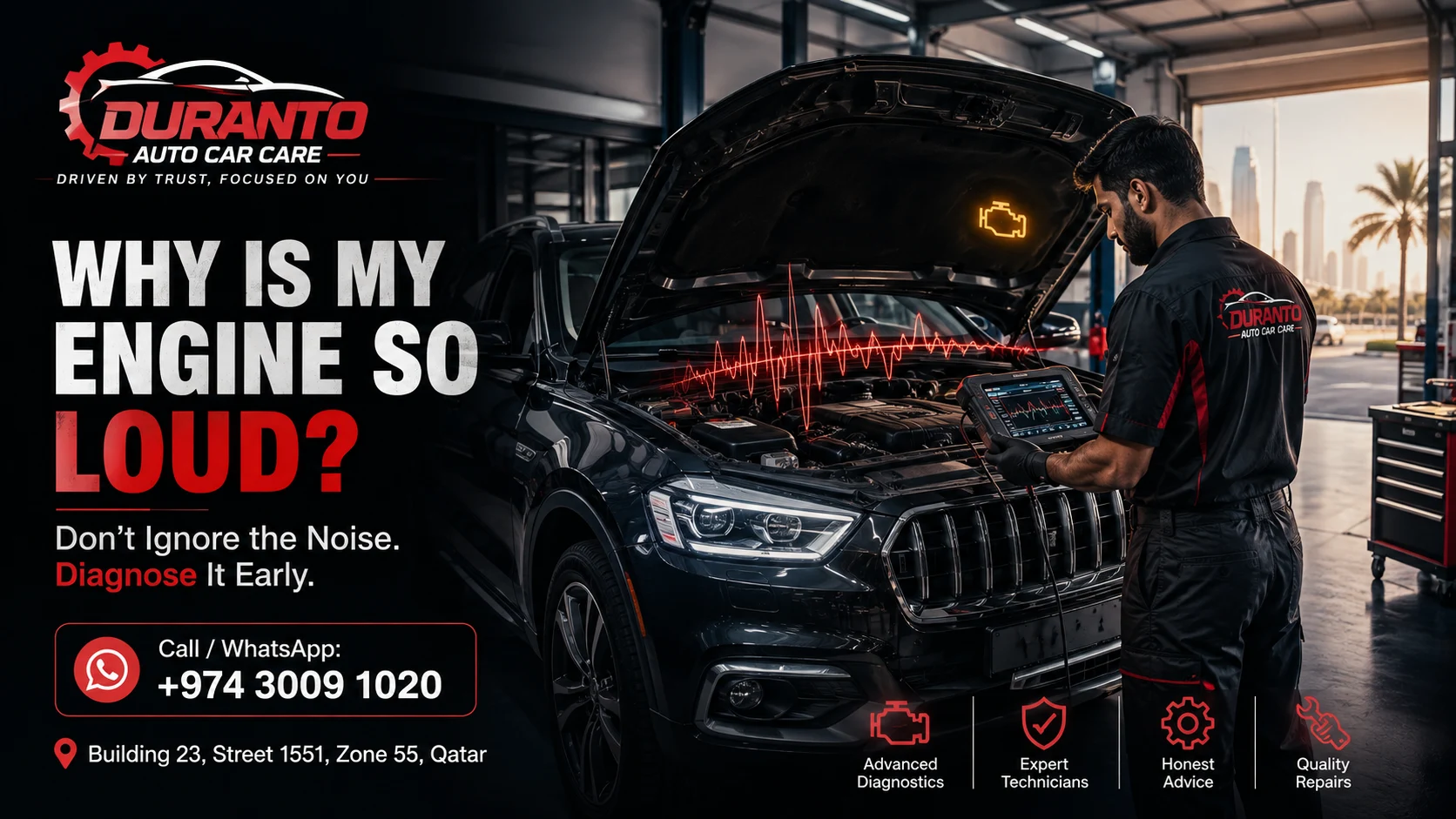
The Usual Suspects (7 Reasons Your Car is Roaring)
Over the years, I’ve narrowed down the causes of excessive engine noise to seven main culprits. Let me walk you through each one.
The Exhaust System, You’re Suddenly a Race Car
Direct Answer: An exhaust leak, especially from a cracked exhaust manifold or rusted muffler, is the number one reason your engine suddenly sounds like a race car. It removes the sound-dampening effect of the exhaust system, letting every explosion roar out, and if your O2 sensor gets contaminated, you’ll also see your Check Engine Light come on.
If your car suddenly sounds like it belongs on a racetrack, your exhaust system is the first place I’d look. Honestly, this is the most common reason people come to us panicking.
Your exhaust system has two jobs: push dangerous gases away from your cabin, and muffle the sound of explosions happening inside your engine.
When there’s a crack, a hole, or a missing part, that muffling effect disappears. Suddenly, you’re hearing every single explosion in full volume.
Definition: Exhaust Manifold. This is the first pipe bolted directly to your engine head. It collects exhaust gases from all cylinders and funnels them into one pipe. If it cracks, you get a loud, rhythmic puffing sound that gets brutal when you accelerate.
Common exhaust issues I see in Doha:
- A rusted or punctured muffler – this literally “un-muffles” the sound.
- A cracked exhaust manifold – this makes a deep rumble that gets worse when you hit the gas.
- A loose or broken pipe – you’ll hear a rattle first, then a roar.
- A stolen catalytic converter – yes, this happens here. Thieves cut them off for the precious metals inside. If yours is gone, your car will sound like a monster truck on startup, and your Check Engine Light will almost certainly illuminate because the downstream O2 sensor will detect the failure.
Definition – Catalytic Converter: A device in your exhaust that turns harmful gases into less toxic emissions. It also helps muffle sound. If it’s stolen or clogged, your car gets LOUD. Cost to replace? 1,500-4,000 QAR depending on the car.
Definition – O2 Sensor: An oxygen sensor mounted in your exhaust pipe that monitors the air-fuel ratio. A failing or contaminated O2 sensor can cause your engine to run rich or lean, creating additional noise and triggering your Check Engine Light.
Quick Answer – Exhaust issues: If the roar gets louder when you press the gas, it’s almost certainly an exhaust leak. Look under the car; if you see a gap or a missing chunk of pipe, that’s your culprit. If you smell rotten eggs, it’s the catalytic converter failing internally. Either way, don’t ignore it; exhaust fumes can enter your cabin, and carbon monoxide is deadly.
Qatar-Specific Warning: Our summer heat is brutal on metal.
Your exhaust pipes are constantly expanding in the day and contracting at night. That stress causes cracks. If you ever smell a rotten egg odor inside your cabin alongside that loud noise, it’s your catalytic converter failing. And if you smell raw exhaust fumes, pull over immediately. That’s carbon monoxide, and it’s a killer.
Engine Oil: The Silent Scream
Direct Answer: A rhythmic ticking or clicking that gets louder when you accelerate is almost always caused by low engine oil or oil that has turned to sludge. That ticking is metal grinding against metal, and if you ignore it, you’re destroying your engine bearings and possibly your timing chain. Switch to fully synthetic oil to protect your engine in Qatar’s heat.
Now, let’s talk about the most common mistake I see. A driver comes in complaining about a ticking or knocking sound that gets louder when they accelerate. Nine times out of ten, they haven’t checked their engine oil in months.
Engine oil is the lifeblood of your motor. It creates a hydrodynamic cushion between metal parts that are moving at insane speeds. When that oil level drops, or when the oil turns into thick sludge because you ignored your oil change, that cushion disappears. Metal grinds against metal. And that grinding sounds exactly like what it is: destruction.
Definition – Synthetic Oil: A laboratory-engineered lubricant that performs better in extreme temperatures than conventional oil. In Qatar’s brutal heat, fully synthetic oil resists breakdown much longer and provides better protection for your engine bearings and timing chain.
Definition – Timing Chain: A metal chain that synchronizes the rotation of your crankshaft and camshaft, ensuring your engine’s valves open and close at the right time. A timing chain failure is catastrophic it can destroy your entire engine. Clean engine oil is critical to keeping your timing chain tensioner working properly.
The ticking time bomb: If you ignore low oil pressure, you’re looking at worn engine bearings, scored cylinder walls, or a seized engine. Yes, seized. As in, you need a new car. And if your timing chain tensioner fails due to low oil pressure, you’re looking at a 5,000+ QAR repair.
Qatar Driving Reality: In Qatar, our oil degrades faster. Period. The stop-start traffic in Doha, the long highway runs, and the 50-degree heat break down oil additives in half the time the manufacturer suggests.
If you’re following the standard 10,000 km schedule, you’re playing with fire. In our climate, I recommend 5,000 to 7,000 km using fully synthetic oil. Yes, it costs more. But it costs a lot less than an engine rebuild.
Belts and Pulleys, That Annoying Squeal
Direct Answer: That high-pitched squeal or chirp under your hood is your serpentine belt slipping or a failing pulley bearing crying for attention. In Qatar, our overworked AC compressor speeds up serpentine belt wear, making this a common summer complaint. If the belt snaps, you lose your water pump and your engine overheats.
Ever heard a high-pitched squeal or chirping coming from under the hood? That’s your serpentine belt crying for help. This belt runs your alternator, power steering pump, water pump, and, crucially in Qatar, your air conditioning compressor.
Definition: Serpentine Belt: A single, long rubber belt that snakes around multiple pulleys. It drives all your engine’s accessories. When it glazes over or cracks, it slips and squeals. If it snaps, your water pump stops turning, your engine overheats, and you’re looking at a blown head gasket.
Our AC runs non-stop for nine months a year. That puts constant strain on the serpentine belt and the pulleys it wraps around. Over time, the rubber glazes over, cracks appear, and the belt starts slipping. That slipping creates a squeal that changes pitch when you rev the engine.
The pulley problem: Even if the serpentine belt looks fine, the tensioner pulley or idler pulleys can fail. A failing bearing in a pulley makes a grinding or whining noise. If you hear that, don’t drive far. If that belt snaps, your water pump stops turning, your engine overheats, and you’re looking at a blown head gasket.
Internal Bearings, The Death Knock
Direct Answer: A deep, heavy, rhythmic knock coming from the bottom of your engine means your engine bearings are failing; this is the sound of imminent engine death. Turn it off immediately and call a tow truck. Do not drive another meter. This is often caused by prolonged low engine oil pressure or using the wrong oil viscosity.
Alright, this is the one that scares even me. If you hear a deep, rhythmic knocking coming from the bottom of your engine, especially when you accelerate, you’ve got an engine bearing problem.
Definition: Rod Knock: The sound of a connecting rod bearing failing. It’s a deep, metallic thud that pounds in time with your engine RPM. It means the clearance between the rod and crankshaft is too big, and they’re slapping together.
Here’s what’s happening: your connecting rods and crankshaft spin on bearings. When oil pressure drops or the engine oil turns to sludge, these bearings wear out. The clearance between the moving parts increases, and they start slapping against each other. That’s the knock.
Rod knock is the sound of your engine dying. It’s not a suggestion. If you hear this, turn off the engine immediately and call a tow truck. Driving even a few kilometers can send a rod through the engine block, turning a 3,000 QAR repair into a 15,000 QAR replacement.
Engine Mounts, Why Your Steering Wheel Shakes
Direct Answer: If your steering wheel shakes violently at idle and the engine noise feels like it’s vibrating through the cabin, your engine mounts have collapsed. The engine is physically touching the car frame, transmitting every vibration and noise directly into your steering wheel and seats.
Your engine doesn’t just float in the engine bay. It’s held in place by rubber or liquid-filled engine mounts that absorb vibration. When these mounts crack or collapse, the engine physically touches the car’s frame.
Definition: Engine Mount: A rubber or hydraulic component that secures your engine to the chassis while absorbing vibration. When they fail, you feel every engine movement in the cabin.
The result? You feel intense vibration in the steering wheel, and the loud engine noise transmits directly into the cabin. It feels like your car is falling apart, but the engine itself is fine. It’s just bolted to the chassis with no cushion.
A quick test: put the car in Drive, hold the brake, and rev the engine slightly. If the noise and vibration spike dramatically, your engine mounts are toast.
Spark Plugs, Misfires and Backfires
Direct Answer: A rough, irregular popping or backfiring sound usually points to old or dirty spark plugs causing misfires. If your Check Engine Light is flashing, pull over immediately; you’re destroying your catalytic converter with unburnt fuel, and your O2 sensors will fail soon after.
Spark plugs ignite the fuel in your engine. When they get old or dirty, they misfire. That means fuel doesn’t burn when it should. Instead, it explodes in the exhaust manifold, creating a loud popping or backfiring sound.
Definition: Spark Plug: A small electrical device that ignites the air-fuel mixture in your engine’s cylinders. Worn spark plugs cause misfires, which create popping sounds and trigger your Check Engine Light.
You might also notice the engine running rough, hesitating, or feeling sluggish. If your Check Engine Light is flashing, that’s your car screaming at you to stop driving. A flashing CEL means active misfire, and active misfire will destroy your catalytic converter in a matter of miles. The unburnt fuel will also contaminate your O2 sensors, adding another 1,000 QAR to the repair bill.
Vacuum Leaks: The Hissing Snake
Direct Answer: A hissing or whistling noise that increases with RPM is a classic sign of a vacuum leak unmetered air sneaking into your intake through a cracked hose or manifold. This messes with your Mass Air Flow (MAF) Sensor readings, making your engine run lean, rough, and noisy.
If you hear a hissing or whistling sound, you’ve got a vacuum leak. Your engine sucks in air through a sealed intake system. If there’s a crack in the intake manifold or a loose hose, extra air is pulled in through the breach. That creates a high-pitched whistle that gets louder when you accelerate.
Definition: Vacuum Leak: An unintended gap in the intake system that allows unmetered air to enter the engine. This messes up the air-fuel ratio, causing rough idle, hesitation, and that hissing noise.
Definition: Mass Air Flow (MAF) Sensor: A sensor that measures the amount of air entering your engine so the ECU can calculate the correct fuel delivery. A vacuum leak causes unmetered air to bypass the MAF sensor, making your engine run lean (too much air). This creates a harsh, pinging sound and can damage your engine over time.
In Qatar’s dusty environment, intake parts crack more easily. Sand and heat make plastic brittle. A vacuum leak also messes with your air-fuel mixture, causing your engine to run rough and burn extra fuel.
Listen Up: Noise Diagnosis Matrix (What It Means + Cost)
Direct Answer: The type of noise roar, tick, knock, squeal, hiss tells you exactly which system is failing and how urgently you need to act. Use this comparison table to match your sound to the likely cause and estimated repair cost in Qatar.
Not all loud noises are the same. Here is a quick-reference comparison table that tells you exactly what that sound means, how urgent it is, and roughly what it will cost to fix in Qatar. This is the table I use with my customers when they first roll into the garage.
| Sound Type | What It Usually Means | Urgency Level | Rough Repair Cost (QAR) |
| Deep Rumble / Roar | Exhaust leak, damaged muffler, failed catalytic converter, or stolen converter | High | 200 – 4,000+ |
| Rhythmic Ticking / Clicking | Low engine oil, worn lifters, timing chain tensioner issue | High (Immediate – check oil) | 50 (top-up) – 2,500 (timing chain) |
| Heavy Knocking (Lower End) | Worn engine bearings, rod knock, severe oil starvation | CRITICAL – Tow it | 3,000 – 15,000+ |
| Squealing / Chirping | Worn serpentine belt or failing tensioner pulley | Medium-High | 150 – 800 |
| Hissing / Whistling | Vacuum leak, intake manifold crack, MAF sensor issue | Medium | 50 – 1,000 |
| Metallic Grinding | Failed water pump, torque converter, transmission bearing | VERY HIGH – Tow it | 1,000 – 6,000+ |
| Rattling (At Idle) | Loose heat shield, exhaust baffle, or engine mount | Low-Medium | 50 – 400 |
Which noise is most dangerous? The heavy knock wins by a mile. It means imminent engine death. The ticking is the second most dangerous because it means you’re low on oil and starving the engine, which can also damage your timing chain. Everything else is annoying but usually safe to drive to a shop.
Instead of guessing which category your noise falls into, book a professional inspection with Duranto Auto Care. We have the diagnostic equipment to listen to your engine’s heartbeat and identify issues before they leave you stranded.
The Real Cost of Ignoring a Roaring Engine in Qatar
Direct Answer: Ignoring a loud engine noise in Qatar can turn a 200 QAR exhaust weld into a 5,000 QAR engine rebuild within weeks. Every day you wait, the damage multiplies and the repair bill skyrockets, and your Check Engine Light will eventually confirm the bad news.
I see it every week. A customer comes in, says they’ve been hearing a noise for a few weeks. They didn’t have time to bring it in. They thought it would go away. Now they’re staring at a repair bill that makes their eyes water.
Let me break it down:
- A 200 QAR exhaust weld could have fixed it. Instead, they kept driving, the leak got bigger, the O2 sensor got contaminated, and the catalytic converter failed. Now it’s 2,000 QAR plus new O2 sensors.
- That ticking sound was low engine oil. They ignored it. Now the engine bearings are shot. 5,000 QAR minimum and possibly a new timing chain tensioner too.
- Then there’s the fuel economy. A roaring engine is often an inefficient engine. You’ll be filling up at the petrol station more often because your Mass Air Flow (MAF) Sensor is reading incorrectly.
- Don’t forget the annual Fahes inspection. Qatar’s vehicle inspection uses a decibel meter. If your car exceeds 79 decibels, you fail. Simple as that. They’ll also check your Check Engine Light; if it’s on, you fail immediately.
- And the worst-case scenario? Breaking down in the desert in August. That’s not a joke. That’s dangerous.
Why Qatar’s Weather Hates Your Car
Direct Answer: Qatar’s extreme heat and sand degrade engine oil twice as fast, crack rubber components, and shorten the life of your serpentine belt and engine mounts. Your car needs a shorter service interval to survive our summers, and don’t forget to check your Mass Air Flow (MAF) Sensor regularly.
Let’s be real. We don’t drive in Seattle. We drive in a place where the asphalt melts in August. That heat does things to your car:
Thermal Degradation – Your engine oil breaks down 30% faster. Your rubber hoses crack. Your serpentine belt glazes over prematurely. Your battery life shortens.
Sand and Dust – It gets everywhere. It clogs your air filter. It contaminates your Mass Air Flow (MAF) Sensor. It makes your engine work harder.
Stop-Start Traffic – Doha’s traffic means your engine spends more time idling and accelerating than cruising. That stresses your engine mounts and your timing chain.
Highway Speeds – Long runs to Al Khor or Saudi Arabia mean sustained high RPMs, which exposes hidden weaknesses in your exhaust manifold, engine bearings, and catalytic converter.
Aggressive Driving – We all love that quick launch from the traffic lights. But it puts immense strain on your drivetrain, engine mounts, and O2 sensors.
If you’re driving a car that was designed for a European climate, you need to adapt your maintenance schedule to Qatar. End of story.
Your Step-by-Step Action Plan (Don’t Panic, Do This)
Direct Answer: If you hear a new engine noise, stop, check your engine oil level, look for visible exhaust leaks, and if the noise is a heavy knock, call a tow truck immediately. For everything else, book a diagnostic inspection today, and if your Check Engine Light comes on, don’t ignore it.
Alright, you’ve got a loud engine. Here’s what I want you to do right now:
Step 1 – Stop and Listen
Pull over safely. Don’t keep driving if it sounds really bad. Listen to the noise. Is it a tick, a knock, a squeal, or a roar? Use my cheat sheet above.
Step 2 – Check the Dipstick
Pop the hood. Check your engine oil level. Is it low? Does it look like black sludge? If it’s low, top it up with the correct grade, ideally fully synthetic oil for Qatar’s climate. If it’s sludge, you need an oil change immediately.
Step 3 – Look Under the Car
See anything hanging down? Any obvious holes in the exhaust pipe? Any fluid leaking? Give it a quick visual. Check if your catalytic converter is still there; thieves target them.
Step 4 – The Rev Test
With the car in Park, safely rev the engine to about 2000 RPM. Does the noise get worse with RPM? If yes, it’s engine-internal (bearings, timing chain, lifters) or serpentine belt-related. If it’s loudest when you lift off the gas, it’s exhaust-related.
Step 5 – Call a Professional
I know you want to save money, but guessing is expensive. At Duranto Auto Care, we have the diagnostic tools to pinpoint the exact cause in minutes, whether it’s a faulty O2 sensor, a cracked exhaust manifold, or worn engine bearings. Bring it in before the problem escalates.
How to Keep Your Engine Quiet in This Heat
Direct Answer: The single best way to prevent loud engine noise in Qatar is to change your engine oil every 5,000 km using fully synthetic oil and inspect your serpentine belt, engine mounts, and exhaust before summer hits. Prevention is always cheaper than repair.
Prevention is cheaper than repair. Always has been. Here’s my honest advice for Qatar drivers:
Aggressive Oil Changes – Do it every 5,000 km in summer. Use fully synthetic oil. Don’t cheap out on the oil filter. Clean engine oil protects your timing chain, bearings, and lifters.
Exhaust Inspections – Have it checked every spring. Before the heat hits. Look for rust and cracks in the exhaust manifold and check your O2 sensors.
Serpentine Belt Replacements – Replace your serpentine belt every 60,000 km. Replace the tensioner at the same time. It’s not worth the risk – if it snaps, your water pump stops and your engine overheats.
Spark Plugs – Use the correct heat range for our climate. Replace them at the manufacturer’s interval (usually 30,000-50,000 km) to prevent misfires that destroy your catalytic converter and contaminate your O2 sensors.
Air Filter – Check it at every oil change. Replace it if it’s dusty. Our desert air clogs them fast, which affects your Mass Air Flow (MAF) Sensor readings.
Cooling System – Make sure your radiator is clean, and your fans are working. Overheating kills engine oil, and dead oil kills your engine bearings and timing chain.
Schedule your preventative maintenance with Duranto Auto Care today. Our team will create a custom service plan tailored to your vehicle and driving habits in Qatar’s unique environment.
Red Flags: When to Call a Tow Truck Immediately
Direct Answer: Call a tow truck immediately if you have a flashing Check Engine Light, a heavy metallic knock, an oil pressure warning, or smoke and fumes in the cabin. These are signs of imminent, catastrophic failure; don’t risk driving another meter.
Listen, I want you to be safe. If you experience any of these, do not drive to the garage. Call a tow truck:
Your Check Engine Light is flashing. This means an active misfire; you’re destroying your catalytic converter and contaminating your O2 sensors with every rotation.
You hear a metallic, hammering knock from the lower engine. That’s rod knock – your engine bearings have failed. Driving even a few meters can send a rod through the block.
Your oil pressure warning light is on. Your engine oil pressure has dropped to zero. The engine is running without lubrication. Your bearings and timing chain are being destroyed.
You smell fuel or burning oil inside the cabin. This is a fire risk and a health risk. Pull over immediately.
Smoke is pouring from your exhaust. White smoke means a coolant leak (head gasket). Blue smoke means burning oil (worn piston rings). Black smoke means running too rich; your O2 sensors and catalytic converter are failing.
Safety Reminder: Carbon monoxide is invisible and deadly. If you feel dizzy or lightheaded while driving, pull over, turn off the car, get out, and call for help.
Your Questions Answered (FAQ)
Why is my engine making a loud sound when I accelerate?
Usually an exhaust leak (cracked exhaust manifold), low engine oil, or spark plug misfire. The added load of acceleration exposes the weakness. If your Check Engine Light is on, have the O2 sensors checked too.
Can I drive with a car engine roaring from an exhaust leak?
You can, for a short distance. But it’s not smart. It can damage your O2 sensors and catalytic converter over time. Plus, exhaust fumes, including carbon monoxide, can enter your cabin.
How often should I change my engine oil in Qatar?
Honestly? 5,000 km or 6 months using fully synthetic oil. Our heat is brutal. Don’t follow the European 10,000 km schedule here your engine bearings and timing chain will thank you.
Why does my engine noise disappear after the car warms up?
That’s a failing timing chain tensioner or hydraulic lifters. Cold engine oil pressure is low, so parts rattle. As it warms up, pressure builds. Don’t ignore this it indicates wear that will eventually fail.
My car sounds louder after an oil change. Why?
Three possibilities: they used the wrong viscosity (not the recommended grade), the engine oil level is off, or a coincidental issue like a vacuum leak or bad Mass Air Flow (MAF) Sensor appeared. Check the dipstick and call the garage.
Is a loud exhaust legal in Qatar?
No. The limit is 79 decibels. If you’re louder than that, you’ll fail the Fahes inspection. They’ll also check your Check Engine Light – if it’s on, you fail.
Why is my engine roaring when the AC is on?
The AC compressor adds load. If your engine mounts are worn or your radiator cooling fan is running at max, you’ll hear the strain. Could also be a failing compressor bearing.
Final Word: Your Engine is Talking, Listen to It
Direct Answer: Your engine makes noise to warn you: listen now, fix it cheap, or ignore it and face a devastating repair bill. A 500 QAR problem today is a 5,000 QAR nightmare next month, and your Check Engine Light will be there to remind you.
Look, I love driving in Qatar. There’s nothing like hitting the open road toward the dunes, or cruising along the Pearl in the evening. But that freedom depends on one thing: a reliable car.
When your engine gets loud, it’s not trying to annoy you. It’s communicating. That roar could be a cracked exhaust manifold. That tick could be low engine oil destroying your bearings. That squeal could be your serpentine belt about to snap. And if your Check Engine Light comes on, it’s confirming what your ears already heard.
Don’t be the guy who says, “I’ll fix it next week.” Because next week, that 500 QAR problem will be a 5,000 QAR nightmare with a dead catalytic converter, failed O2 sensors, and possibly a seized engine.
If your engine has suddenly become louder, don’t rely on guesswork. The certified technicians at Duranto Auto Care in Qatar can diagnose the issue using professional diagnostic equipment and years of local experience.
We’ll check your engine oil, inspect your exhaust manifold, test your O2 sensors, scan your Check Engine Light codes, and identify exactly what’s wrong. Contact us today for a comprehensive inspection before a minor annoyance turns into a major repair bill. Drive safe, drive quiet, and let us keep your engine running smoothly in the Qatar heat.
Book your inspection now at Duranto Auto Care because peace of mind starts with a healthy engine.
Duranto Auto Care vs. The Competition (Honest Comparison)
Direct Answer: For diagnosing a loud engine, Duranto Auto Care specializes in fast, accurate root-cause analysis using advanced diagnostic tools, while dealerships focus on warranty work and general shops handle basic repairs. Here’s an honest comparison to help you choose.
Let’s cut through the marketing fluff. Here is what you’re actually signing up for with each option in Qatar:
| Feature | Duranto Auto Care | Authorized Dealerships (e.g., Mannai) | General Repair Workshops | FAHES Inspection Centers | Mobile Repair Services |
| Primary Focus | Engine diagnostics & repair | Brand-specific service & warranty | General mechanical repairs | Vehicle compliance only | Roadside fixes |
| Diagnostic Gear | Advanced scanners, stethoscope, O2 & MAF testing | Manufacturer-specific tools | Basic OBD-II scanners | Noise level meters | Limited tools |
| Technician Credentials | ASE Certified & Qatari-licensed | Dealer-trained | Varies massively | Inspection officers only | Varies |
| Speciality | Engine noise, bearings, timing chain, exhaust | Brand-specific issues | General fixes | Compliance checking | Quick fixes & towing |
| Turnaround Time | Same-day diagnosis | 2-5 days (appointment) | 1-3 days | 30-60 mins (inspection only) | 1-2 hours |
| Price Point | Competitive & transparent | Premium (dealer rates) | Cheap to medium | QAR 150 approx. | Medium to high |
| Parts Used | OEM & high-quality aftermarket | Genuine OEM only | Varies | N/A | Varies |
| Warranty | Workmanship warranty | Manufacturer warranty | Varies | N/A | Limited |
| Qatar Climate Experience | 35+ years combined | Extensive (brand network) | Varies | Regulatory only | Varies |
| Best For | Diagnosing loud noise, bearings, timing chain, O2 sensors | Warranty cars, brand-specific parts | Oil changes, basic repairs | Annual inspection | Tyres, batteries, towing |
So, which one should you choose?
Choose Duranto Auto Care if you hear a noise and don’t know what it is. We specialize in finding the root cause, whether it’s a failed catalytic converter, worn engine bearings, a bad Mass Air Flow (MAF) Sensor, or a cracked exhaust manifold.
Choose an Authorized Dealership if your car is under warranty and you need specific software updates or genuine OEM parts. Just be ready for the bill.
Choose a General Workshop if you just need an engine oil change and you know the guy personally.
Choose FAHES Inspection only if you’re just getting your annual sticker; they don’t fix anything. They’ll just tell you if your Check Engine Light is on or if your exhaust exceeds 79 decibels.
Choose a Mobile Service if you’re stranded with a flat tyre or dead battery. For complex engine noise like a timing chain issue, faulty O2 sensors, or a bad catalytic converter, you’ll still need a proper workshop.