
Let me tell you about a conversation I had last July with Rashid, a mechanic at a workshop in Doha’s Industrial Area for Car Maintenance Qatar. He was leaning against a dusty Land Cruiser, wiping his hands on a rag that had seen better days. Book Mobile Mechanic Qatar
“You know what I tell every customer who walks in here between June and September?” he said, shaking his head. “I tell them: ‘Your car wasn’t built for this. Neither was mine. But yours has to survive it.'”
He pointed to a BMW on the hoist behind him. “That one? The owner ignored the temperature gauge for three days. ‘I’ll get it checked next week,’ he said. Next week cost him 6,500 QAR for a new cylinder head.”
Rashid has been fixing cars in Qatar for twelve years. He’s seen every possible way a vehicle can fail in this climate, and almost all of them were preventable.
Proper vehicle maintenance in Doha isn’t complicated. It’s not expensive. And it’s not optional. It’s the difference between a car that lasts ten years and a car that dies in three. Whether you need auto repair services in Qatar or a quick oil change, the principles are the same: regular attention, quality parts, and knowing what to look for.
I’m not here to scare you. I’m here to give you the information that Rashid wishes every driver in Doha already knew, straight from the mechanics, the service centres, and the drivers who’ve learned these lessons the hard way.
Chapter 1: Why Qatar Is a Vehicle’s Worst Nightmare
Let’s be honest: Qatar’s summer is brutal.
We’re talking air temperatures that regularly exceed 45°C. The Qatar Meteorology Department recorded a record-breaking temperature of 50.4°C in July 2010. The highest recorded temperature in June was 49.1°C in 2010, and the highest in August was 48.6°C in 2002. Road surface temperatures climb significantly higher; conventional black bituminous pavements absorb a large proportion of solar radiation, leading to surface temperatures exceeding 65–75°C during peak summer conditions. Some studies have recorded asphalt temperatures of 80°C or more. Humidity soars near the coast. Fine dust from the shamal winds clogs everything. And salty, humid air near The Pearl and West Bay accelerates corrosion.
Here’s what that means for your vehicle, according to the mechanics who deal with it every day:
- Coolant lifespan drops from 3 years to under 18 months in Qatar conditions.
- Battery life is cut in half—from 4–5 years to just 2–3, making emergency battery replacement a frequent necessity.
- Rubber components—hoses, belts, tyres—degrade faster due to UV exposure and constant heat stress.
- AC systems run flat-out for the entire drive, increasing demand for automotive air conditioning repair services.
- Mineral deposits build up quickly in cooling systems, especially if plain tap water has ever been used as a top-up.
Most vehicles are designed and tested for temperatures between -20°C and 38°C. In Qatar, we’re operating in conditions that push every single system to its absolute limit. That’s why regular vehicle servicing in Qatar is essential.
Proper car care in hot climates isn’t just about keeping your vehicle comfortable; it’s about keeping it alive.
Rashid told me something that stuck with me: “In winter, a car with a weak cooling system might run fine. You won’t know there’s a problem until July, when the ambient temperature is 45°C, and the thermal margin becomes zero.”
The cost of neglect? Thousands of QAR in repairs. The cost of prevention? A few hundred QAR and a couple of hours of your time. That’s why regular automotive service appointments are the smartest investment you can make.
Chapter 2: Engine Oil, The Lifeblood of Your Car Maintenance Qatar
Here’s what happens inside your engine on a 47°C day in Doha.
Your engine oil is working harder than you are. It’s being pumped through metal components at high speed, absorbing heat, and trying to maintain its protective properties. But heat oxidises oil molecules. It darkens the fluid and reduces its ability to lubricate.
“Most people don’t realise that heat and dust place greater stress on engine oil and can accelerate oil degradation,” a technician at a Doha workshop told me.
The warning signs are there if you know what to look for:
- Rising oil consumption
- Rough idle
- Engine noise that wasn’t there before
- Dark, burnt-smelling oil on the dipstick
Skipping or delaying an oil change in Doha is one of the fastest ways to invite sludge, increased wear on camshafts and bearings, sticky hydraulic lifters, and, in severe cases, catastrophic engine failure.
So what should you do?
Most manufacturers recommend oil changes every 10,000–15,000 km on high-quality synthetic oil. But that’s in mild climates. Manufacturer maintenance schedules are calibrated for moderate climates where summer temperatures reach 30°C at most. In Qatar, many workshops, including respected garages across Doha, recommend shorter intervals.
Best practice for vehicle maintenance in Doha: mineral oil should be changed every 5,000 km or 3 months, semi-synthetic every 7,500 km or 5 months, and full synthetic every 10,000 km or 10 months. Use the correct viscosity for Qatar heat. And always use a genuine oil filter.
Fresh oil with the right additives resists thinning and oxidation under Qatar summer loads. It keeps your engine cleaner, improves fuel economy, and dramatically cuts wear rates.
Think of it as the cheapest insurance you can buy for your car. When you book your next automotive service appointment, make sure this is at the top of the list.
Chapter 3: Cooling Systems, Because Overheating Is a Serious Threat
Remember Rashid’s BMW story from the introduction? That customer ignored the temperature gauge for three days. “I’ll get it checked next week,” he said. Next week cost him 6,500 QAR.
According to industry experts, driving just 2 km with a dangerously overheating engine can cause cylinder head gasket damage—a repair costing 5 to 10 times the cost of fixing the original cooling fault.
Let me put that in perspective. Catching a partially blocked thermostat before summer costs 80 to 150 QAR to replace. The head gasket damage it causes if it fails in summer costs 2,000 to 8,000 QAR to repair.
That’s not a typo. Two thousand to eight thousand QAR. For ignoring a thermostat. Engine overheating is one of the most common and expensive repair issues in Doha.
Why cooling systems fail in Qatar:
Qatar’s cooling systems face a perfect storm. At highway speed, airflow through the radiator cools the engine effectively even in hot weather. But in stationary or slow traffic, and Doha traffic is famous for this, the engine relies entirely on its electric cooling fan.
If that fan is weak, if coolant is low, or if the thermostat is starting to stick, temperatures climb with nothing to compensate. A radiator is designed to keep your engine at around 90–95°C—the normal operating water temperature for most family cars. A typically safe engine coolant temperature range is between 90–105°C. In the UK or Europe, that job is relatively easy. In Qatar, the radiator is fighting against 45–50°C ambient temperatures, sand-clogged condenser fins, and coolant that degrades far faster due to heat cycling.
Essential cooling system checks:
- Coolant level—check every two weeks in summer
- Coolant condition—old coolant loses effectiveness
- Radiator condition—blocked or leaking radiators cause rapid overheating
- Cooling fans—must work properly at all times
- Thermostat—a stuck thermostat causes overheating
Warning signs your cooling system needs attention:
- Temperature gauge rising above the midpoint, especially in slow traffic or at idle
- Sweet smell coming from the engine bay or vents—this is ethylene glycol (coolant) burning off
- Coloured puddle under the car—coolant is typically green, orange, pink, or blue
- Heater blowing cold air despite the engine being fully warm—a sign of low coolant or a blocked heater core
- White or grey smoke from the exhaust—this is a serious symptom indicating coolant entering the combustion chamber
- Coolant level dropping repeatedly without a visible external leak
If your temperature gauge rises: Turn off the AC immediately. Switch the heater to maximum heat and fan speed; this draws heat away from the engine. Move to the right lane and prepare to pull over. If the gauge enters the red, stop and turn off the engine. Call a mobile mechanic Qatar. Do not continue driving.
Prevention is cheaper than repair.
A full cooling system service, including coolant flush and thermostat testing, should be done before summer. A coolant flush and refill typically costs around 100 to 250 QAR. A radiator hose replacement costs 80 to 200 QAR per hose. A thermostat replacement costs 150 to 350 QAR including parts.
Chapter 4: The Battery, Summer’s Biggest Victim
If there’s one component that suffers most in Qatar’s heat, it’s the battery.
“Battery failure spikes dramatically in June and July in Qatar,” according to industry reports. Batteries that started the car reliably all winter suddenly fail when summer temperatures push engine bay temperatures above 70°C and ambient temperatures exceed 45°C.
Here’s why: parking in direct sun raises battery temperature by 15–25°C above ambient. In Qatar’s summer, this pushes battery temperature to 65–75°C—well above the rated maximum for most batteries. The heat accelerates electrolyte evaporation and plate corrosion beyond the battery’s rated operating conditions.
A battery rated for 4 to 5 years in European conditions typically provides 2 to 3 years in Qatar, sometimes as little as 18 months.
The battery is the number one cause of summer breakdowns. On-site battery replacement is one of the most requested emergency services during June, July, and August.
What to do:
- Have the battery tested; most workshops and roadside services do it for free in minutes
- Check for corrosion or a swollen case
- If your battery is over 18 months old, have it load-tested before summer
- Any battery below 70% capacity should be replaced before summer
- Park in shade whenever possible
Costs: A new standard battery typically costs around 200 to 500 QAR fitted, more for larger SUVs. Emergency battery replacement with a mobile service typically costs 250 to 620 QAR depending on vehicle and battery brand.
Do not wait for the battery to fail in July at 45°C. Replace it proactively. A mobile mechanic Qatar can come to you and replace it on the spot.
Chapter 5: Tyres, The Only Thing Between You and the Road
Here’s a fact I learned from a tyre specialist in the Industrial Area: road surface temperatures in Qatar can exceed 70°C. Conventional black bituminous pavements absorb a large proportion of solar radiation, leading to surface temperatures exceeding 65–75°C during peak summer conditions. Some studies have recorded asphalt temperatures of 80°C or more.
Your tyres are literally cooking.
Automotive care in extreme heat requires extra attention to your tyres because the combination of extreme temperatures, long highway stretches, and sudden braking in traffic creates the perfect storm for tyre problems.
“Tyre blowouts increase in summer when higher ambient temperatures raise tyre pressure and soften already-degraded rubber compounds on older tyres,” according to industry experts. “An aged tyre at already elevated pressure that hits a speed bump at speed in July heat creates conditions for catastrophic blowout.”
What to check:
- Tyre pressure—check at least monthly, in the morning when tyres are cool. Follow the pressures on the sticker inside the driver’s door.
- Tread and sidewalls—inspect for cracks. UV and heat crack old rubber.
- Tyre age—check the four-digit date code on the sidewall. Any tyre over 5 years old should be replaced before summer.
- Don’t forget the spare and the jack.
In Qatar’s conditions, tyre rotation every 8,000 to 10,000 km is recommended, more frequent than the typical 12,000 to 15,000 km interval in cooler climates.
Costs: Tyre puncture repair typically costs 60 to 120 QAR. New tyre fitting fee is 80 to 150 QAR per tyre, with tyre prices starting from 180 QAR for budget options. A full tyre care service will typically include pressure check, rotation, and inspection.
Chapter 6: Air Conditioning, Your Best Friend in Summer
Let’s be real: in Qatar, your Car AC Repair Qatar isn’t a luxury feature. It’s a core safety and performance component.
A parked car left in the sun can reach well over 60°C inside within minutes. A failing AC in Doha’s heat is not just uncomfortable; it’s dangerous. That’s why automotive air conditioning repair is one of the most sought-after services during summer months.
“AC failures peak in July and August when the system is under maximum continuous demand,” according to industry reports. “Compressor wear from year-round operation, refrigerant leaks that reduce cooling effectiveness gradually, and cabin filters so clogged with dust that airflow is severely restricted all converge in summer.”
Signs your car AC needs attention:
- Warm or weak airflow from vents
- Strange smells when AC is on
- AC takes long to cool the cabin
- Unusual noises from the AC compressor
- AC cuts in and out randomly
What to check:
- AC gas (refrigerant) level—low gas is the most common AC problem in Qatar summers
- AC compressor condition—the heart of your AC system
- Cabin air filter—Qatar’s dust clogs them fast and cuts airflow; replacement costs 80 to 180 QAR
- AC belts and connections
The smart move: Service the AC system every March before summer begins. A comprehensive annual AC service in March or April includes refrigerant level check and recharge if needed (150–280 QAR for R134a, 250–450 QAR for R1234yf), compressor operation test, and cabin filter replacement. A full AC service typically costs 200 to 450 QAR and prevents a summer repair under emergency conditions at a potentially higher cost.
Costs: Compressor replacement can cost QAR 2,500–5,000+. The choice is obvious. Professional automotive air conditioning repair services can diagnose and fix most issues without requiring a full compressor replacement if caught early.
Chapter 7: Brakes, Suspension, and Steering, The Safety Trifecta
Qatar’s roads aren’t exactly smooth. Potholes, speed bumps, and the occasional construction zone accelerate wear on suspension and steering.
When do you need mechanical repairs?
- Grinding or squealing brakes
- Steering vibration or pulling to one side
- Clunking over bumps (worn suspension links)
- Soft or spongy brake pedal
- Oil or fluid leaks from under the car
Regular brake and suspension checks are part of proper vehicle servicing in Qatar. A periodic service includes a detailed braking and suspension system inspection. Don’t skip it.
Costs: Brake pad replacement per axle costs 200 to 500 QAR depending on vehicle and pad specification.
Chapter 8: The Service Schedule, What to Do and When
Understanding vehicle services is the first step towards being a smart vehicle owner. Whether you book a vehicle service appointment at a workshop or call a mobile mechanic Qatar, every vehicle has a minor and major maintenance scheduling cycle.
Quick Service (15–30 minutes):
- Engine oil and filter change
- Top-up of critical fluids (brake fluid, engine coolant, washer fluid)
- Quick visual inspection, up to 25 basic checkpoints
- Every 5,000 km or 3 months
Periodic Service:
- Everything in quick service plus 20 additional checkpoints
- Engine air filter—Qatar’s sand clogs these faster than in cleaner-air regions
- Cabin air filter—replace every 6 months for clean AC airflow
- Tyre rotation—front and rear wear evenly
- Detailed braking and suspension system inspection
- Replacement of defective parts found during inspection
- Every 10,000–15,000 km or 6 months
Major Service:
- Everything in periodic service
- Replacement of spark plugs, transmission oils, air filters, drive belts
- Brake pads—check thickness; Qatar’s traffic conditions wear pads faster than highway driving
- Brake fluid—replace every 2 years or 40,000 km
- Transmission oil—maximum 40,000 km lifespan in Qatar conditions
- Every 20,000–40,000 km
Manufacturer’s Service:
- Most comprehensive service, covers almost 50 major checkpoints
- Follows all manufacturer replacement policies
- Ideal for vehicle performance and extended lifespan
Pro tip: The maintenance program should be discussed with a mechanic and optimised by your driving pattern and type of usage. A car that does short urban trips needs different attention than one that does long highway drives. March and April represent the critical pre-summer maintenance window for automotive service appointments.
Chapter 9: Fahes, The Annual Inspection You Can’t Skip
Want to pass Fahes on the first try? Professional pre-inspection vehicle checks can help you avoid the stress and expense of a failed inspection.
FAHES is Qatar’s mandatory annual vehicle inspection scheme run by WOQOD. WOQOD Vehicle Inspection (FAHES) is the only company licensed to conduct inspections of light vehicles, heavy vehicles, and heavy equipment in Qatar. FAHES offers a highly technically oriented inspection of vehicles in conformity with the approved standards of road traffic safety and pollution control.
The mandatory vehicle inspection has three main purposes:
- Reduce the number of deaths and injuries caused by vehicle components or system failure.
- Increase the number of legally compliant vehicles on the road.
- Reduce the environmental impact caused by vehicles.
What they check:
The vehicle inspection is conducted following Qatar & GCC Standards with respect to vehicle road safety, environmental, and legal requirements. The inspection allows the MOI (Traffic Department) to check that every vehicle complies with the minimum standards for roadworthiness, emissions, and legal compliance at the time of the inspection.
The Fahes vehicle inspection consists of three stages:
- Exterior inspection—lights, tyres, vehicle body condition
- Functional tests—brakes, shock absorbers, exhaust emissions
- Underbody inspection—chassis, suspension, fuel system
Fees:
| Vehicle Category | Fee |
| Private Passenger Car | QR 150 (estimate) |
| Light Vehicle (Taxi, Private & Public Transport less than 3000kg) | QR 160 (estimate) |
| Heavy Vehicle (Private & Public Transport more than 3000kg) | QR 250 (estimate) |
| Trailer/Semi Trailer | QR 300 (estimate) |
| Motorcycle | QR 100 (estimate) |
| Haj Bus | QR 550 (estimate) |
Payment Method: Card payment only.
Important: If the first re-inspection is a ‘FAIL’, the subsequent re-inspection is a paid inspection at the normal main inspection rate. If a vehicle doesn’t PASS within 30 days of the first main inspection, all previous reports and repairs will be ignored, and a new main inspection will take place.
Pro tip: Regular automotive care in extreme heat throughout the year means you’re more likely to pass Fahes on the first try. A Pre-Fahes inspection costs 150 to 250 QAR and can save you from failing and having to pay for reinspection. Don’t wait until the week before your inspection to discover your brakes are worn, or your tyres are bald. It is the user’s responsibility to keep the vehicle in a safe, roadworthy, and environmentally friendly condition throughout the year. Many vehicle servicing providers in Qatar offer Fahes Preparation Qatar preparation packages.
Chapter 10: Automotive Service Costs in Qatar, What to Expect
One of the most common questions drivers ask is: “How much is this going to cost me?” Here’s a transparent breakdown of typical auto repair costs based on 2025–2026 pricing from across Doha’s service providers.
Engine Oil & Filter Change
- Small car, standard synthetic: 190 to 280 QAR
- Medium car, full synthetic: 250 to 370 QAR
- Large SUV V8, full synthetic: 320 to 450 QAR
- European long-life oil: 340 to 520 QAR
Emergency Battery Replacement (including installation)
- Small car (Yaris, Corolla, Sunny, Accent): 250 to 380 QAR
- Medium sedan (Camry, Altima, Tucson, Sportage): 300 to 450 QAR
- Large SUV (Land Cruiser, Patrol, Fortuner): 400 to 600 QAR
- American SUV (Yukon, Suburban, Expedition): 380 to 550 QAR
- European car, standard battery (Varta Blue Dynamic): 350 to 550 QAR
- European car, AGM (BMW, Mercedes, Audi): 500 to 900 QAR
Tyre Care Services
- Puncture repair (permanent plug and patch): 60 to 120 QAR
- Spare wheel fitting: 80 to 130 QAR
- New tyre fitting fee: 80 to 150 QAR per tyre
- New tyre prices: from 180 QAR (budget) to 400+ QAR (premium)
Automotive Air Conditioning Repair
- Cabin filter replacement: 80 to 180 QAR
- Refrigerant recharge (R134a): 150 to 280 QAR
- Refrigerant recharge (R1234yf): 250 to 450 QAR
- Full AC service: 200 to 450 QAR
Brake Service
- Brake pad replacement per axle: 200 to 500 QAR
Diagnostic & Inspection
- Battery load test only: 50 QAR (credited if replacement follows)
- Diagnostic scan: 80 to 150 QAR (included in repair visits)
- Pre-Fahes inspection: 150 to 250 QAR
Full Vehicle Service Appointment
- Full service for most passenger cars: 350 to 700 QAR including parts and labour
All prices include: Technician’s travel to your location, no callout fee; night and weekend service at the same price; old oil and battery disposal; all fluid top-up checks; service receipt documenting all work completed.
Chapter 11: Where to Find Reliable Automotive Services in Doha
Qatar has no shortage of garages and service centres. But not all are created equal. Here’s what you need to know about finding trustworthy auto repair services Qatar.
Types of Service Providers
Traditional Workshops:
Full-service garages with lifts, diagnostic equipment, and comprehensive repair capabilities. Best for major repairs, body work, and complex diagnostics. Typically located in the Industrial Area or dedicated automotive zones.
Mobile Mechanics:
Certified technicians who come to your location—home, office, or roadside. Best for routine maintenance, battery replacement, AC service, and minor repairs. Response times typically 30–45 minutes in Doha.
Tyre and Battery Specialists:
Focused providers who specialise in tyres, batteries, and related services. Often offer mobile fitting and emergency callout.
How to Choose the Right Provider
- Check Reviews — Google Reviews, social media, and word of mouth are reliable indicators of quality.
- Ask for Written Estimates — Reputable providers give clear breakdowns of parts and labour before starting work.
- Verify Technician Certification — Qualified mechanics should have manufacturer training or recognised certifications.
- Look for Genuine Parts — Quality providers use OEM or OEM-specification parts, not cheap substitutes.
- Check Warranty — Work should be backed by a service warranty.
Quality Indicators
- Transparent pricing with no hidden fees
- Upfront quotes before work begins
- Photo updates on request (especially for mobile services)
- Service receipts documenting all work completed
- Clean, professional facilities or well-presented mobile units
Red Flags to Avoid
- Pressure to do extra work on the spot
- Refusal to show old parts after replacement
- Vague estimates or verbal-only quotes
- Cash-only payment insistence
- Unprofessional communication or frequent rescheduling

Chapter 12: How to Book Your Automotive Service Appointment
Booking your vehicle service appointment has never been easier. Whether you prefer a workshop or a mobile mechanic, here’s how to get started:
Option 1: Mobile Mechanic Qatar Services
- Saaed Service: Call or WhatsApp +97430091020 — 24/7 anywhere in Qatar
- The Automan Services: Call +97430091020 — 24/7 anywhere in Qatar
- On The Go Garage: Available 24/7 across all of Qatar
Option 2: Traditional Workshop Services
- Al Muftah Garage: Call +97430091020 or visit www.almuftahgarage.com
- Al Muftah Garage Al Wakra: New branch now open, serving the southern region
What to Have Ready When You Call
- Vehicle make, model, and year
- Current mileage
- Description of the issue or service needed
- Your location (for mobile services)
- Preferred date and time
Payment Methods
Most providers accept card payments, bank transfers, and in some cases, cash. Mobile services typically offer upfront quotes before any work begins.
Chapter 13: Summer Car Care Tips, Your Seasonal Checklist
When the temperature climbs, your car needs extra attention. Here are practical summer car care tips that every driver in Qatar should follow:
Weekly Checks During Summer
- □ Tyre pressure (cold, morning)
- □ Coolant level (when engine is cold)
- □ Engine oil level
- □ Windscreen washer fluid
- □ All exterior lights
Monthly Checks During Summer
- □ Battery terminals for corrosion
- □ Air filter condition
- □ Belts and hoses for cracks
- □ Air conditioning performance
- □ Brake pad thickness
Before Any Long Summer Journey
- □ Full fluid check
- □ Tyre condition and pressure
- □ Spare tyre and jack
- □ Emergency contact numbers saved
- □ Mobile mechanic Qatar number saved
Cost-Saving Tips
- Schedule pre-summer service in March/April
- Combine services to save on callout fees
- Use mobile services to avoid taking time off work
- Request detailed quotes before work begins
Chapter 14: Resources for Vehicle Care in Qatar
Here are some of the best resources I’ve found for vehicle care in Qatar:
- Fahes Official Website — fahes.com.qa for inspection requirements and fees
- Qatar Meteorology Department — For official temperature records and climate data
- Qatar Living — Summer vehicle maintenance checklist
- The Peninsula Qatar — 7 essential tips for vehicle upkeep in Qatar’s summer heat
- QIC Online — Fahes vehicle inspection guide
- Al Muftah Garage — Comprehensive guides on summer preparation, AC repair, engine cooling, battery care and tyre maintenance
- Saaed Service — Radiator repair, coolant service, comprehensive repair guides, transparent pricing
- Miles Automobiles — Technical consultation and service assistance
Frequently Asked Questions About Vehicle Care in Qatar
To help you plan your maintenance budget and make informed decisions, here are the most common practical questions we hear from drivers across Doha, Lusail, Al Wakrah, and beyond.
How much should I expect to pay for a standard oil change in Doha?
For a standard 4-cylinder car with synthetic oil, expect to pay between 190 and 370 QAR at most garages. For larger SUVs or luxury vehicles requiring more oil and premium filters, the cost can range from 320 to 520 QAR. This usually includes the oil filter and a basic multi-point inspection. Mobile services typically charge no callout fee—the price you’re quoted is the price you pay.
Is it worth hiring a mobile mechanic Qatar instead of going to a garage?
If you value time and convenience. Mobile mechanics in Doha typically arrive within 30 to 45 minutes and can perform 80% of routine maintenance (oil changes, battery swaps, AC recharge, brake pad replacement) right in your parking spot. Paying slightly more per service to save 3 to 4 hours of your day is, for most professionals in Qatar, an obvious value trade. However, for major engine overhauls or transmission work, a workshop with a lift and specialised tools is still the better choice.
What is the most common cause of AC failure in Qatar cars, and how can I prevent it?
According to AC specialists, the number one cause is refrigerant leakage, often through microscopic pores in the condenser or evaporator, accelerated by Qatar’s heat and vibration. The second most common is a completely clogged cabin air filter, which restricts airflow and causes the evaporator to freeze up. Prevention is simple: replace your cabin filter every 10,000 km (or annually) for 80 to 180 QAR and have a professional check your system pressure every spring. A small leak detected early can be sealed for under 200 QAR; a dead compressor from running low on gas can cost over 2,500 to 5,000 QAR. Professional automotive air conditioning repair services can diagnose the issue before it escalates.
Can I just use regular tap water instead of coolant in Qatar?
Please do not do this. I asked Rashid this directly, and he practically shouted, “Never.” Regular tap water in Qatar has high mineral content. Over time, these minerals deposit inside your radiator and engine block, forming scale that blocks cooling passages and drastically reduces heat transfer. Worse, plain water boils at 100°C, whereas a 50/50 coolant mix boils at around 126°C and protects down to -36°C. Water also lacks corrosion inhibitors. If you use only tap water for even one summer, you will have rust and scaling that shortens your radiator life by years. Always use the correct premixed coolant or distilled water with concentrate. Flush and refill the cooling system as recommended by the manufacturer and servicing schedule.
How long does a Fahes inspection actually take on the day?
The physical inspection itself takes about 10 to 15 minutes per vehicle. However, with queuing and document verification at the testing centre, you should budget 45 to 90 minutes total. Peak times (mid-June to August and the last week of each month) can see lines stretching up to two hours. The best time to go is Tuesday or Wednesday mornings right after they open at 7:00 AM. Remember, the test is valid for one year from the date of inspection, so you don’t have to wait until your registration expiry; you can take it up to 90 days early. FAHES has one permanent station in the industrial area, comprising 6 lanes and 3 mobile units. The private passenger car fee is QR 150; the motorcycle fee is QR 100. Professional pre-inspection vehicle checks can help ensure you pass without issues.
What exactly should I do if my car overheats in stop-and-go traffic on the Doha Expressway?
This is a real scenario, and panicking makes it worse. Here’s the step-by-step from the mobile mechanics:
- Turn off the AC immediately—this reduces engine load.
- Turn the heater on full blast with maximum fan speed. Yes, it’s hot, but it draws heat away from the engine into the cabin.
- Put your hazard lights on, safely move to the hard shoulder or an exit ramp, and stop.
- Turn off the engine immediately.
- Do not open the radiator cap while the engine is hot—pressurised steam will cause severe burns.
- Call a mobile mechanic in Qatar or roadside assistance. Do not attempt to drive even a few hundred metres further.
Are synthetic oils really better for Qatar’s climate, or is it marketing hype?
It’s not hype. According to multiple workshop managers I interviewed, synthetic oil is objectively superior for Qatar. Conventional oils contain waxes and impurities that break down quickly at 45°C ambient temperatures, forming sludge. Synthetics are chemically engineered with uniform molecules that resist oxidation and maintain viscosity at high temperatures. They also flow better on cold starts (yes, our winter mornings can still be cold enough to matter). Every mechanic I spoke to recommended fully synthetic 5W-30 or 5W-40 for most modern cars in Qatar, changing it every 10,000 km or 10 months for optimal protection.
How do I choose a reliable garage in Doha without getting overcharged?
Start by asking for a written estimate before any work is done. Reputable garages and mobile services provide clear breakdowns of parts and labour. Check their Google reviews and look for recurring complaints. Ask your friends or colleagues in Qatar for personal recommendations; word of mouth is still king here. Finally, a reliable garage will not pressure you to do extra work on the spot; they will explain the urgency and let you decide. If they refuse to show you the old parts after replacement, walk away.
How much does a full vehicle service appointment cost in Qatar?
A full vehicle service for most passenger cars costs between 350 and 700 QAR, including parts and labour. European cars using long-life synthetic oil cost more. A full service includes engine oil and filter replacement, air filter and cabin filter replacement, full diagnostic scan, battery load test, brake inspection, tyre inspection, fluid top-up, visual inspection of belts and hoses, and an AC basic test. Many vehicle servicing providers in Qatar offer packages that bundle these services for better value.
How much does an emergency battery replacement cost in Doha, and what’s included?
Emergency battery replacement costs range from 250 to 900 QAR depending on vehicle size and battery type. All-inclusive prices typically include the battery cost, delivery, installation, alternator test, BMS coding where required (for European vehicles), old battery disposal, and service receipt. There is no additional callout fee for mobile services. Professional on-site battery replacement services can complete the entire process in under 30 minutes at your location.
How can I prepare my car for a Fahes inspection?
Pre-inspection vehicle checks are essential for a first-time pass. Before your inspection, ensure all lights are working, tyres have adequate tread, windscreen wipers are functioning, brakes are responsive, and there are no dashboard warning lights. A professional pre-Fahes inspection typically costs 150 to 250 QAR and includes a full vehicle check against Fahes requirements. Many service providers offer Fahes preparation as part of their vehicle servicing packages in Qatar.
Conclusion: What the Mechanics Want You to Know
Before I wrote this guide, I spent time talking to mechanics across Doha for Car Maintenance Qatar. I asked them one question: “What’s the one thing you wish every driver in Qatar knew?”
Their answers were remarkably consistent.
Rashid, the mechanic from the Industrial Area: “Check your coolant. It’s the cheapest thing you can do. Takes two minutes. Saves you thousands. That’s real vehicle care in Doha.”
A technician at a mobile service: “Don’t wait until something breaks. The heat doesn’t give you warning signs. It just takes things from ‘working’ to ‘broken’ without much in between. That’s why regular automotive service appointments are so important.”
Another mechanic, who’s been working in Qatar for fifteen years: “Your car can survive this climate. But it needs help. Regular maintenance isn’t optional here; it’s survival.”
Here’s the truth about automotive care in extreme heat: it’s not complicated. It’s not expensive. And it’s not optional.
The difference between a car that lasts 10 years and a car that dies in 3 is regular maintenance. The difference between a 200 QAR oil change and an 8,000 QAR engine replacement is a few months of neglect. The difference between a comfortable drive to work and being stranded on the side of Salwa Road in 48-degree heat is a battery check. That’s why services like emergency battery replacement and automotive air conditioning repair are so critical.
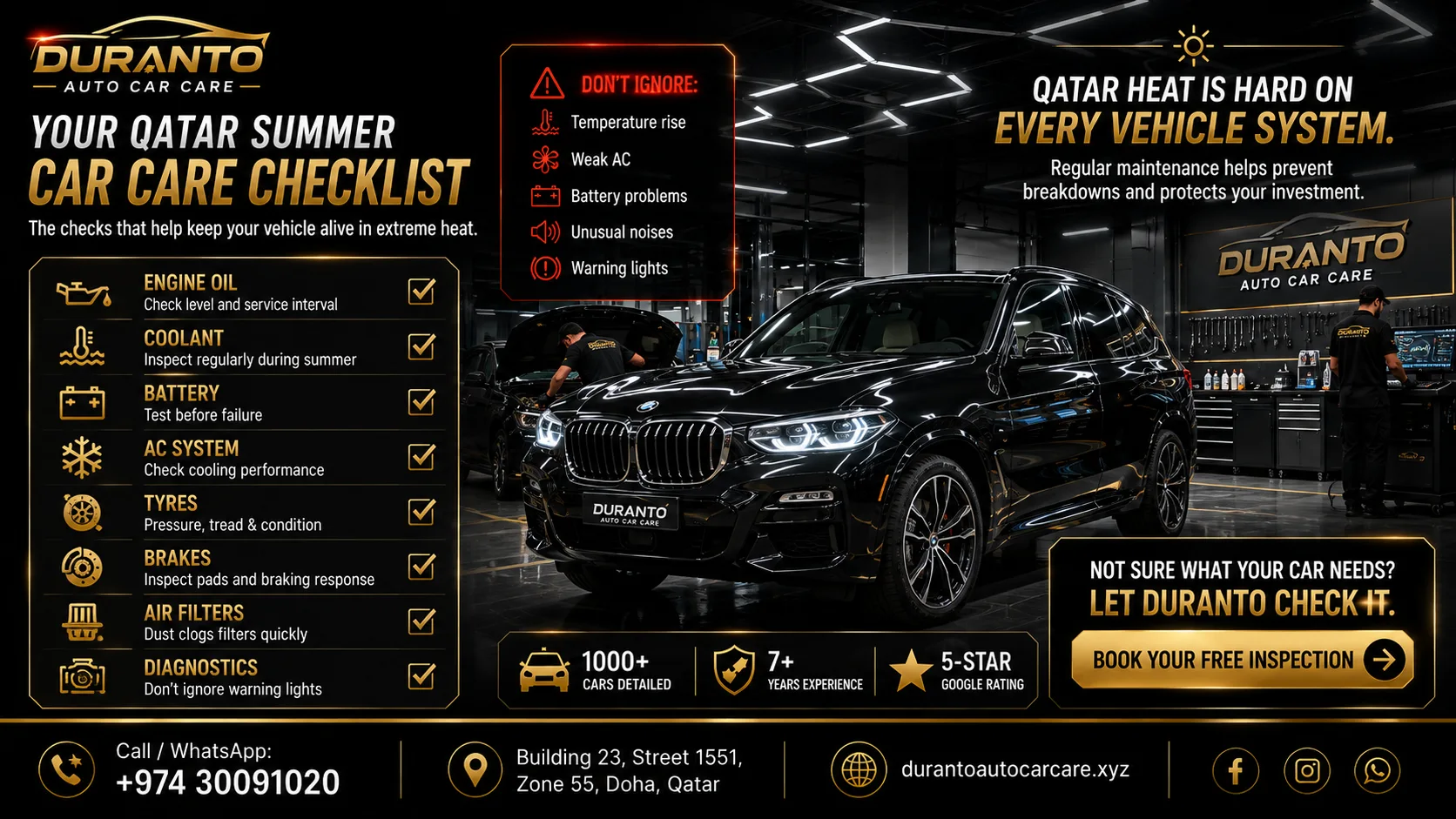
Your Vehicle Care Checklist:
- □ Change engine oil every 5,000 km or 3 months
- □ Check coolant level every 2 weeks in summer
- □ Test battery before summer (and replace if over 18 months old)
- □ Check tyre pressure monthly (morning, when cool)
- □ Rotate tyres every 8,000–10,000 km
- □ Service AC every March before summer
- □ Get periodic service every 10,000–15,000 km
- □ Major service every 20,000–40,000 km
- □ Don’t ignore warning lights or unusual noises
- □ Book your Fahes inspection on time
- □ Consider professional pre-inspection vehicle checks
Ready to book your service? Call one of our trusted providers today:
- Saaed Service (Mobile Mechanic Qatar): +97430091020 — 24/7 anywhere in Qatar
- The Automan Services (Mobile Mechanic Qatar): +97430091020 — 24/7 anywhere in Qatar
- Al Muftah Garage (Workshop): +97430091020 — Birkat Al Awamer & Al Wakra
Vehicle care in Qatar: Contact Us isn’t just about keeping your car running. It’s about keeping you safe. It’s about protecting your investment. It’s about having one less thing to worry about in a country where summer is already hard enough. Whether you need a simple oil change, urgent automotive air conditioning repair, or comprehensive vehicle servicing in Qatar, the key is to act before problems become emergencies.
So go ahead. Check your oil. Top up your coolant. Test your battery. Service your AC.
Your car will thank you. Your wallet will thank you. And your future self, the one who isn’t standing on the side of the road in 50-degree heat waiting for a tow truck, will definitely thank you.